The Angevin Kings… descended from the devil or not?
The Middle Ages was a world filled with myths, legends and superstition. Stories of strange creatures, supernatural happenings and mysterious ancestors became entwined with the histories of families and places, sometimes so successfully that separating legend from history centuries later isn't quite as easy as we might expect.
But where did these stories come from, and how much of what we think we know belongs to history and how much to legend?
The Angevins were hardly known for harmonious family relationships. Henry II spent the later years of his reign facing rebellions by his own sons, while those same sons were quite capable of turning on one another when it suited them. Even by the standards of medieval royal families, theirs could be a spectacularly difficult family, and Richard the Lionheart apparently had a rather intriguing explanation for why this might have been.
Writing in the late twelfth and early thirteenth centuries, Gerald of Wales recorded that Richard would sometimes refer to an extraordinary story about his family's ancestry, suggesting that it was hardly surprising that members of the family fought among themselves when they had come from the devil and would ultimately return to him. Behind Richard's rather wonderful remark lay a strange story about a mysterious Countess of Anjou, and it is here that our attempt to separate history from legend really begins.
According to Gerald, one of the earlier Counts of Anjou had married a woman of extraordinary beauty whose origins were something of a mystery. She bore him children and appeared to fulfil everything expected of a noble wife, but there was one peculiarity that eventually began to arouse suspicion. She was reluctant to attend church, and whenever she did accompany her family to Mass, she would invariably leave before the consecration of the Eucharist.
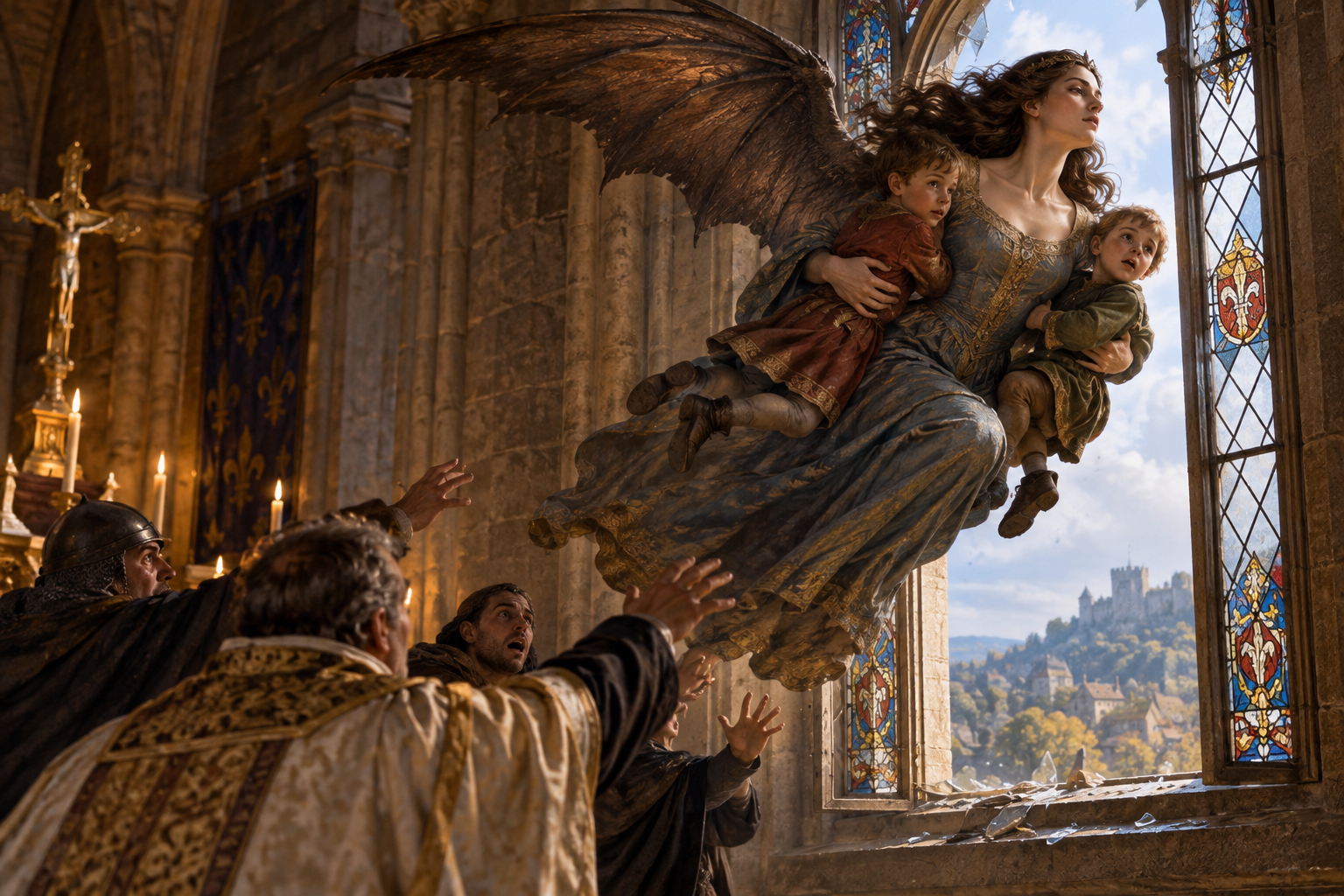
Her husband became determined to discover why. On one occasion, he arranged for four men to surround her as Mass progressed, preventing her from making her usual departure. Faced with the prospect of being forced to remain, the mysterious countess suddenly threw off the cloak of respectability she had maintained for so long. According to Gerald's wonderfully dramatic account, she seized two of her children, flew out through a high window of the church and disappeared, leaving two other sons behind.
It is difficult not to love the sheer drama of the story, although Gerald himself clearly had a purpose in telling it. Those sons who remained behind, he explained, became the ancestors of the Counts of Anjou and, eventually, of the Plantagenet kings of England. The violence and bitter divisions within Henry II's family could therefore be presented as something almost inevitable, the legacy of a dynasty whose origins were believed to lie somewhere rather darker than an ordinary medieval marriage.
The mysterious woman in Gerald's story was never named, but over time another legendary woman has become closely associated with stories of supernatural ancestry in this part of medieval France. Her name was Melusine, and although her story shares some striking similarities with the tale of the Angevin countess, she belongs to a different tradition, most famously connected with the powerful Lusignan family of Poitou.
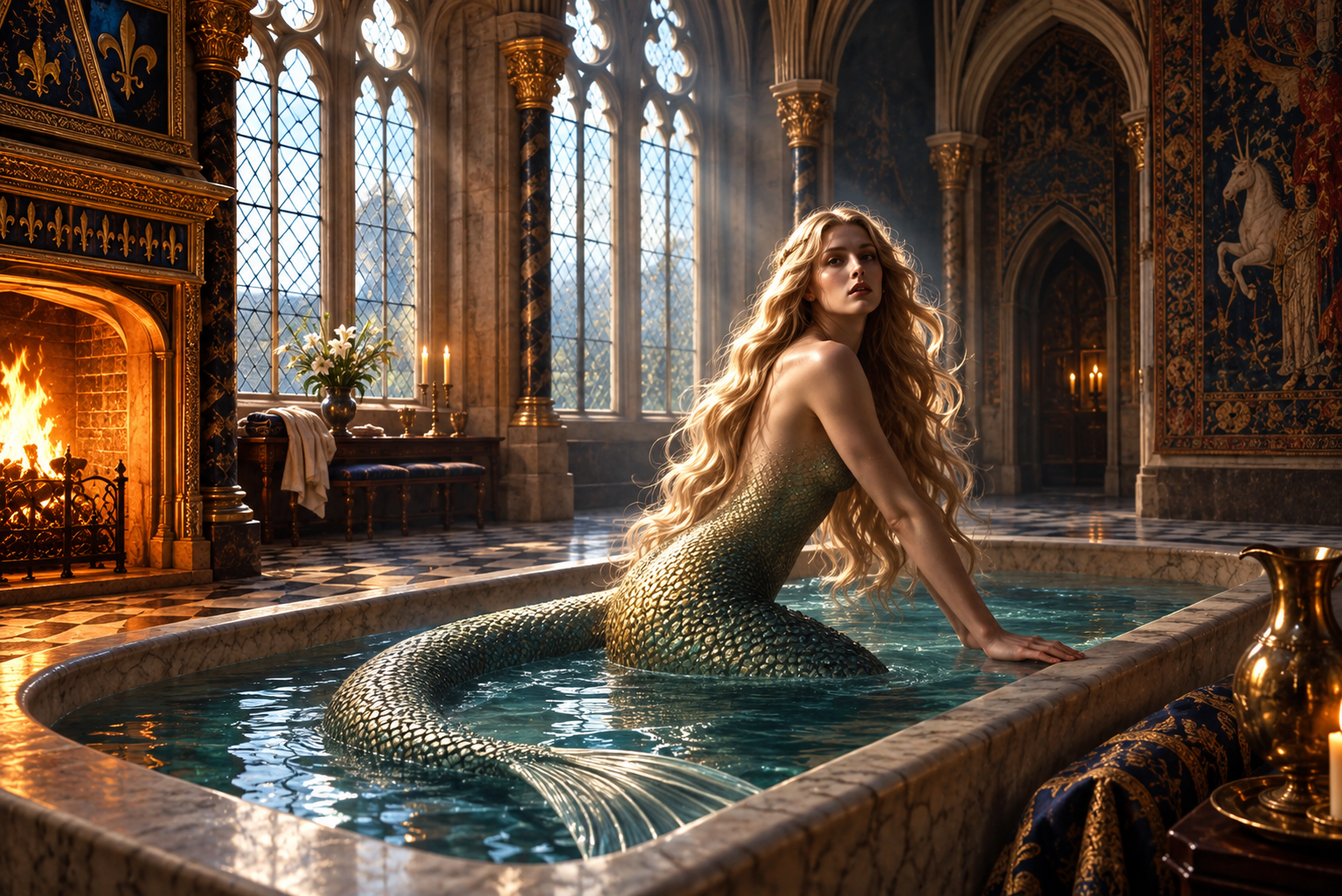
The version of her story that has become particularly well known was written down by Jean d'Arras towards the end of the fourteenth century.
In it, Melusine meets a young nobleman named Raymondin, who is immediately captivated by her beauty and asks her to marry him. She agrees to the marriage and helps him acquire wealth, lands and status, asking only that he make her one promise: every Saturday she is to be left completely alone, and he must never attempt to see her or discover what she does during that time.
For years Raymondin keeps his promise, while Melusine becomes a devoted wife and mother and the source of the family's growing prosperity. Eventually, however, suspicion and curiosity get the better of him. He secretly watches her while she bathes and discovers the truth she has kept hidden from him: from the waist down, his beautiful wife has taken the form of a serpent. If you'd like to see how medieval artists themselves imagined this moment, the Bibliothèque nationale de France preserves this wonderful manuscript illustration showing Raymondin discovering Melusine in her bath.
Raymondin's discovery did not immediately end their marriage. According to Jean d'Arras's version of the story, the greater betrayal came later when, during an argument, he publicly revealed Melusine's secret and accused her of being a serpent. It was this breaking of his promise that finally forced her to leave him. Melusine transformed, flew from the castle and disappeared, although legend held that she continued to return in secret to watch over her children and would appear whenever death or disaster threatened the Lusignan family.
The association with the Lusignans is what makes Melusine particularly interesting in a Plantagenet story. They were one of the most powerful families in Poitou, and Eleanor of Aquitaine had very good reason to know them. In 1168, her party was ambushed while travelling through Poitou by members of the Lusignan family, including Geoffrey and Guy de Lusignan. Her escort commander, Patrick, Earl of Salisbury, was killed, while his nephew, the young William Marshal, was wounded and captured.
That same Guy de Lusignan would later travel to the Holy Land, marry Sibylla, sister of Baldwin IV of Jerusalem, and eventually become King of Jerusalem himself. I can't help wondering what Eleanor would have made of the fact that the supernatural ancestress of the dreaded Lusignans would eventually become so thoroughly tangled with the legend surrounding her own Angevin family.
So we now have two remarkably similar traditions: Gerald of Wales's mysterious Countess of Anjou, whose supernatural nature was revealed when she was prevented from leaving Mass, and Melusine, the supernatural ancestress of the Lusignans whose secret was discovered by a husband who could not resist looking where he had promised he would not. They are not the same woman, despite the way the stories have sometimes become intertwined, but both tell us something fascinating about the place supernatural ancestry could occupy in medieval ideas about powerful families.
So, were the Angevin kings really descended from the devil? I think we can safely leave that one in the realm of medieval legend. What is far more interesting is that the story existed at all, and that Richard the Lionheart apparently knew it well enough to use it when commenting on the extraordinary behaviour of his own family.
Stories such as these became woven into the identities of powerful medieval dynasties, passed down and reshaped as the centuries went by. They offered wonderfully dramatic explanations for families whose wealth, power, ambitions and behaviour could sometimes seem larger than life. Perhaps that is why these legends have survived for so long. We may no longer believe that a countess could sprout wings and disappear through a church window, or that a beautiful noblewoman secretly took on the form of a serpent every Saturday, but more than eight centuries later we are still telling their stories.
And I suspect Richard the Lionheart would have rather enjoyed that.
If the stories of the Plantagenets have captured your imagination, you can explore our current Plantagenet Discoveries journeys and discover the places where so much of their remarkable history unfolded.
Join the Plantagenet Discoveries community
Max
Images: AI Generated for Context