Rouen Cathedral
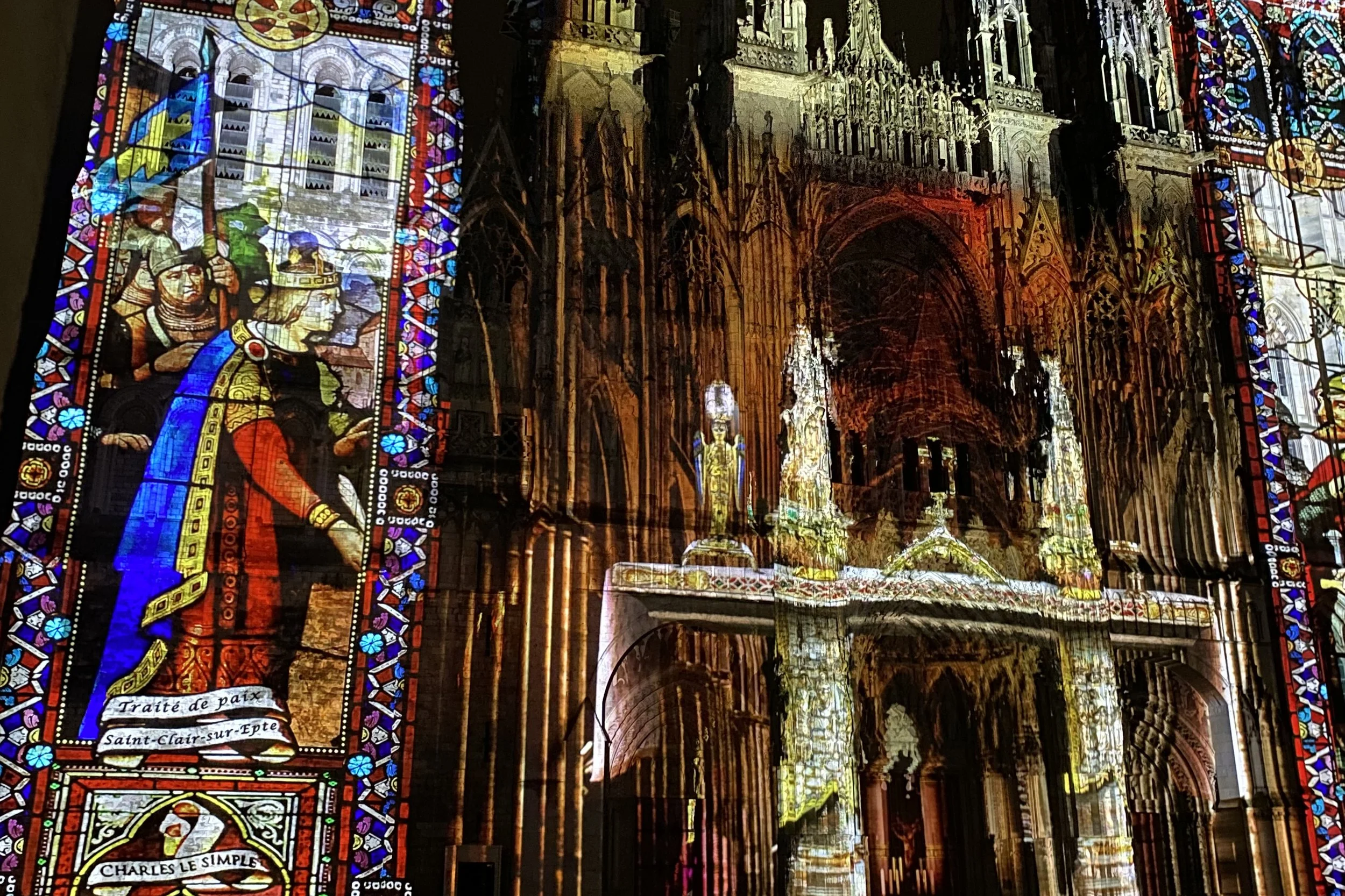
What an introduction!
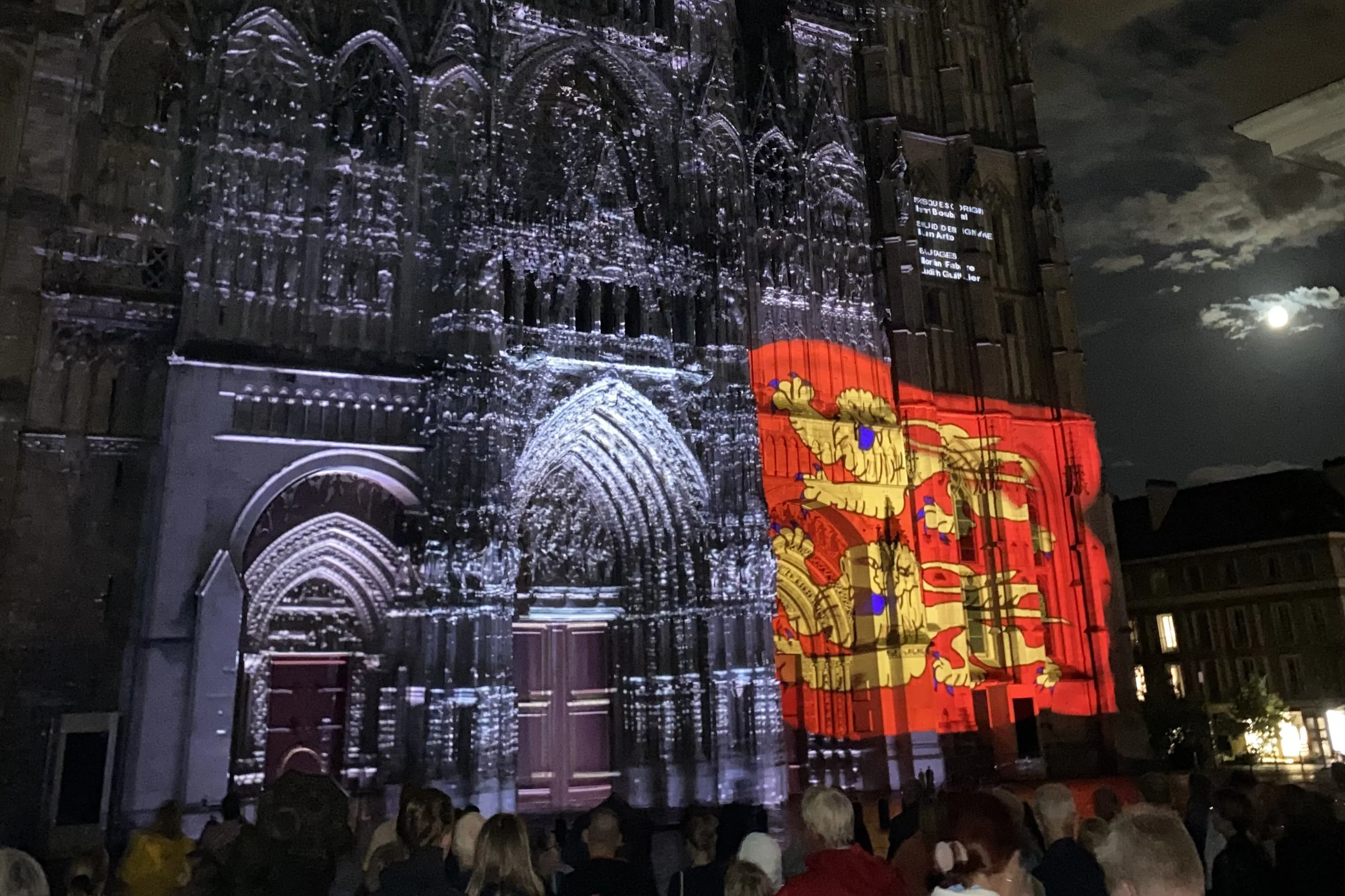
It was September 2022, and that evening, its great façade became the backdrop for an extraordinary light show, with colour, music and images sweeping across a cathedral I had come to see for its Plantagenet connections.
On several visits since, I've discovered that Rouen Cathedral doesn't need a light show to make it fascinating. The stories held within its walls are remarkable enough.
When the Cathedral Became a Canvas
The light show I saw in 2022 told the story of Normandy itself. The enormous façade became a canvas stretching back through centuries, beginning long before the medieval world I had come to Rouen to explore. Early settlements appeared across the stone before the story moved into the Viking age, with runes, shields and the people who would eventually give Normandy its name.
From there, the story continued through kings and the medieval centuries, before history gradually gave way to an extraordinary wash of colour. Watching it unfold across a building that had witnessed so much of that history made the whole experience even more memorable.
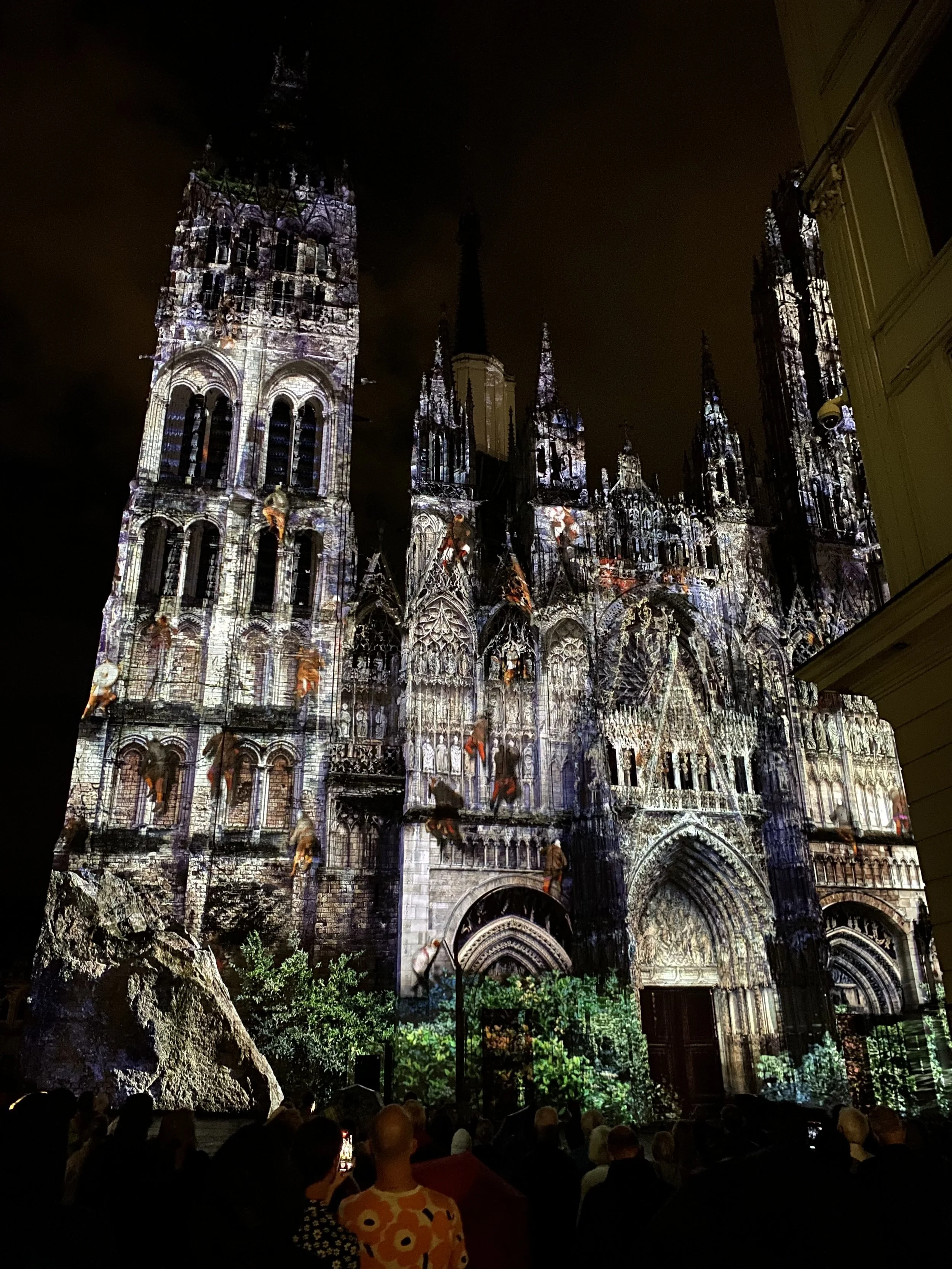
At times it felt as though the cathedral itself had become part of the story. Figures appeared across the stone, climbing over arches, towers and doorways, while the architecture beneath them seemed to shift and change.
That was what made the show so fascinating to watch. You never quite knew what would appear next. One moment the familiar façade of Rouen Cathedral was clearly visible, the next it had disappeared beneath another chapter of Normandy’s story.
Standing in the square with the crowd around us, watching centuries of history move across a building that had witnessed so much of it, was quite an extraordinary way to meet Rouen Cathedral for the first time.
Looking at this blog four years later, I can now add another layer that I couldn’t possibly have known when I first wrote this story. That evening was the beginning of an absolute love affair with this historic city. Rouen has since become my favourite city in France, the place I look forward to visiting each year more than any other place… and I can trace so much of that affection back to standing right there in front of the cathedral that night.
Before the Plantagenets Came the Normans
Rollo, the Viking leader who became the first ruler of Normandy, was baptised at Rouen in the early tenth century as part of his conversion to Christianity. He took the Christian name Robert, a name that would appear again and again among his descendants and the later Dukes of Normandy.
Rollo's connection with Rouen Cathedral didn't end with his baptism. When he died, he was buried here, beginning a relationship between the cathedral and the Dukes of Normandy that would continue for generations.
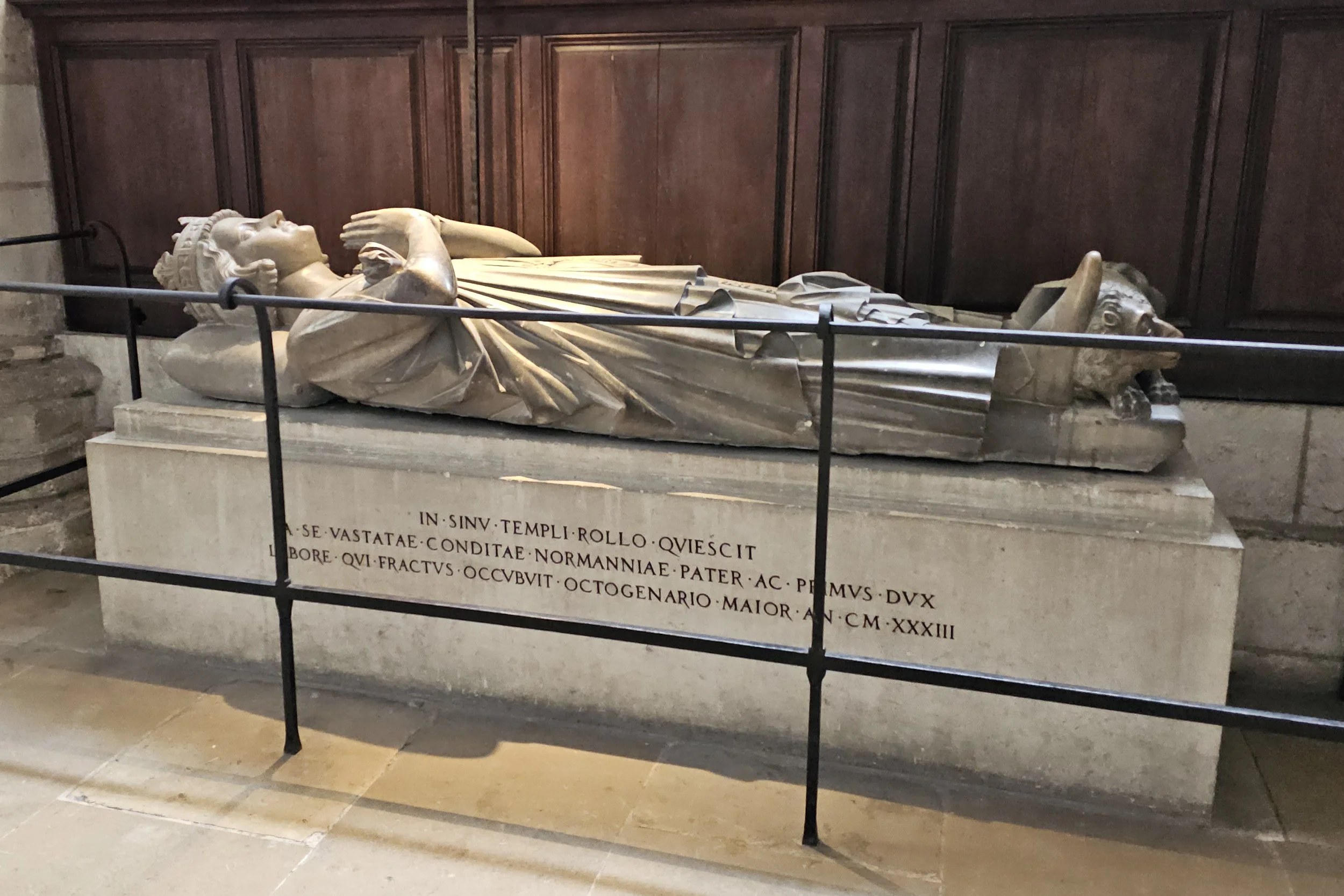
The tomb we stand beside today isn't quite as straightforward as it first appears. Rollo's remains have been moved over the centuries as successive versions of the cathedral were built and rebuilt, and the monument visitors see today is not his original medieval tomb.
Yet I still find something rather wonderful about standing there. Rollo began life as a Viking leader and became the founder of Normandy. More than a thousand years later, we can stand inside Rouen Cathedral, beside the place where he was laid to rest, in the city that became the heart of his new duchy.
Three Years Before the Conquest
More than a century after Rollo's death, one of his descendants stood inside a newly completed Rouen Cathedral for another important moment in its history. On 1 October 1063, the Romanesque cathedral was consecrated by Archbishop Maurille in the presence of William, Duke of Normandy, and his barons. During the same period, the remains of Rollo and his son William Longsword were transferred into the new cathedral.
What I find fascinating is the date. 1063.
William was not yet the conqueror by which history would remember him. He was still Duke of Normandy, standing in his cathedral in Rouen. Three years later, he would cross the Channel, defeat Harold at Hastings and become King of England. A moment that would change the relationship between England and Normandy forever. And although the Plantagenets were still almost a century away from taking the English throne, the cross-Channel world they would inherit was already beginning to take shape.
The Empress Who Returned to Rouen
The Empress Matilda, grand-daughter of the conqueror has a connection with Rouen Cathedral that is much easier to miss. When she died in 1167, Matilda was buried at Bec Abbey, where she had spent considerable time during the later years of her life. Centuries later, after the abbey had suffered through revolution and destruction, her remains were rediscovered and eventually transferred to Rouen Cathedral in 1871.
There is no grand tomb or imposing effigy to draw your attention to her. Instead, an inscription within the cathedral commemorates the woman whose long struggle for the English throne ultimately paved the way for her son, Henry II, to become the first Plantagenet king of England.
I find it rather fitting that Matilda should have eventually returned to Rouen. Normandy had played such an important part in her struggle against Stephen, and here she rests in the same cathedral as two of her Plantagenet grandsons, Henry the Young King and Richard the Lionheart.
A King Buried Twice
Henry the Young King, oldest surviving son of Henry II and Eleanor of Aquitaine, had asked to be buried at Rouen Cathedral, but getting him there proved rather more complicated than anyone might have expected.
When Henry died at Martel in 1183, aged just twenty-eight, his body began the long journey north towards Normandy. Along the way, the funeral party stopped at Le Mans. The following morning, however, the bishop, clergy and people of the city refused to let him leave. Instead, they buried the young king in their own cathedral.
The people of Rouen were not impressed.
Henry had wanted to be buried in their cathedral, and the Rouennais demanded that his wishes be honoured, reportedly threatening to recover his body by force. Eventually Henry II intervened and ordered that his son's body be returned. Poor Henry was exhumed from his first resting place and continued the journey to Rouen, where he was finally buried in the cathedral as he had requested.
His effigy can still be seen there today, a reminder of a young king whose life was complicated enough, and whose journey after death turned out to be rather eventful too.
The Heart of a Lion
Richard the Lionheart's connection with Rouen Cathedral tells a very different story.
When Richard died in April 1199 after being wounded by a crossbow bolt during the siege of Châlus-Chabrol in Aquitaine, his final resting place would not be confined to one location. As was not unusual for someone of his status, his remains were divided between places that held significance in his life. His body was taken to Fontevraud Abbey and buried alongside his father, Henry II, while his entrails were buried at Châlus. His heart was then brought north to Rouen and laid to rest in the cathedral.
Of all the places that could have received Richard's heart, Rouen feels particularly appropriate. Normandy was central to his life and his kingship. He spent years defending the duchy, and just a few years before his death had built the extraordinary Château Gaillard above the Seine as part of that defence.
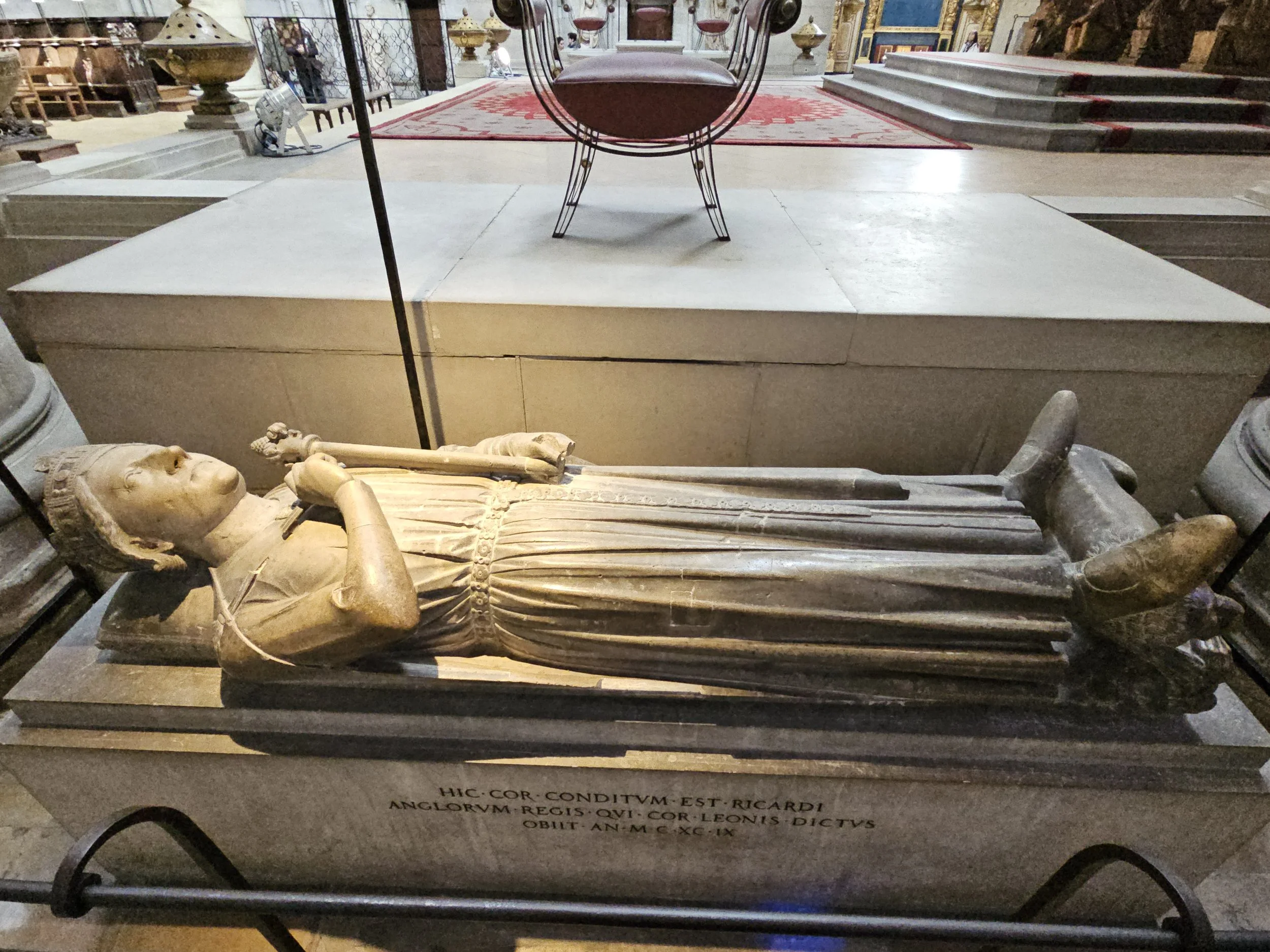
Today, a recumbent effigy of Richard marks the place associated with his heart. The original lead casket containing it was rediscovered beneath the cathedral floor in 1838, bearing an inscription identifying it simply as the heart of Richard, King of England.
There is something about that division of Richard's remains that seems to map out his life. His body at Fontevraud, among his family. His entrails at Châlus, where his final battle ended. And his heart here in Rouen, in the duchy he had fought so fiercely to protect.
These are places that have become part of our own journeys through Plantagenet France.
A Cathedral That Has Endured
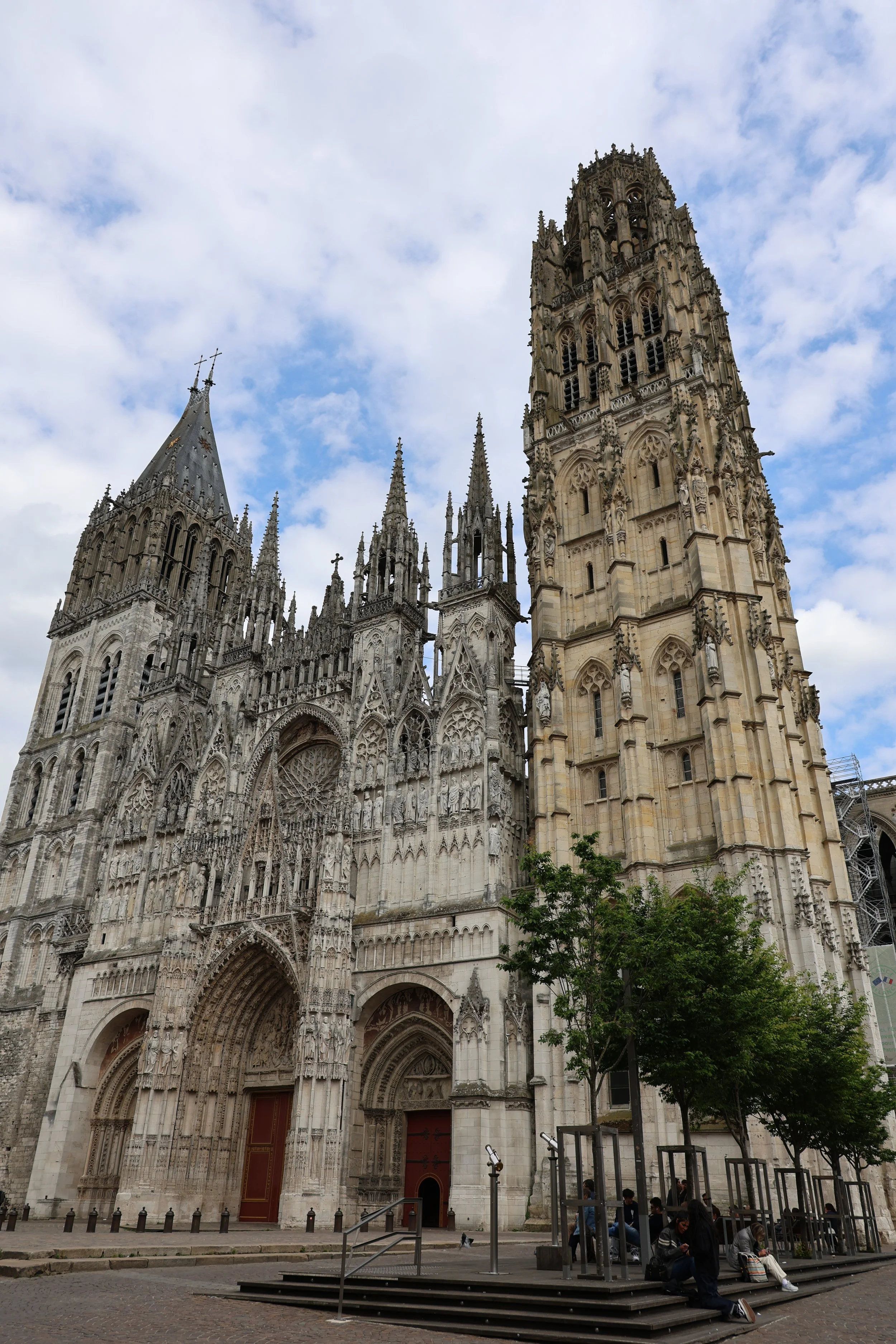
The cathedral we see today was never created in a single moment. It grew and changed over centuries, and you can actually read some of that history in its architecture.
Look at the west façade and the differences are striking. The Saint-Romain Tower, on the left, has its beginnings in the twelfth century, while the Butter Tower, on the right, belongs to the late fifteenth and early sixteenth centuries. Between them, the façade itself carries different stages in the development of Gothic architecture, while the great cast-iron spire soaring above the cathedral belongs to the nineteenth century. The result is an extraordinary record of around 700 years of architectural evolution. If you'd like to explore the different architectural styles in more detail, Rouen Tourism has a wonderful guide to the cathedral and its Gothic architecture.
That mixture exists because Rouen Cathedral has been altered, enlarged, damaged and rebuilt again and again. Fire, lightning, religious conflict and revolution have all left their mark. During the Second World War, Rouen suffered devastating Allied bombing, and in 1944 the cathedral itself was badly damaged. Restoration would become another chapter in its long history.
Perhaps that long history of change is part of what makes the west façade so fascinating. In the 1890s, Claude Monet returned to it again and again, producing a series of around thirty paintings as he explored the way different light, weather and times of day could transform what he saw. More than a century later, light transformed the cathedral again on the evening I first saw it. Monet captured those changes on canvas, while the modern projections used the façade itself as the canvas. In both cases, the stone remained the same, yet what appeared before you could change completely.
Where It All Began
By the end of the light show that September evening, the centuries of images and colour had disappeared. The cathedral stood illuminated against the night sky, with the two lions of Normandy stretched across its façade.
I couldn't have known then how many times I would return to Rouen, or how important the city would become to the journeys I was only beginning to imagine. I certainly couldn't have known that four years later I would call it my favourite city in France.
What began that night with light and music has grown with every visit. I've come to know more of Rouen's streets, its stories and its history, but somehow I always find myself back in front of the cathedral.
Perhaps that's why this image feels like the right place to finish. The light show told the story of Normandy across the walls of Rouen Cathedral. Since then, I've discovered just how many stories those walls already hold.
Max
All Images © Plantagenet Discoveries