Why I chose the Plantagenets?

Of all the periods of history I could have fallen in love with, why the Plantagenets?
I certainly didn't set out to become fascinated by a dynasty that ruled England for more than three centuries. In fact, there was a time when I wouldn't have described myself as particularly interested in history at all.
And then I opened a book.
Now, more than twenty years later, I am still discovering reasons to be fascinated by the family I found within its pages.
A Book on My Sister’s Shelf
The book was Sharon Kay Penman’s The Sunne in Splendour, and I randomly picked it up from my sister’s bookshelf. I knew very little about Richard III at the time beyond the familiar image of the villainous king, and I certainly had no idea that picking up that particular book was about to send me down one of the longest rabbit holes of my life.
What Penman did was make me curious about the person behind the history. Richard became more than a name and a collection of events, and for the first time I found myself wanting to know how much of the story I was reading was based on what we actually knew and how much belonged to the novelist. That curiosity sent me looking for more.
And there was plenty more to find.
I stayed with Penman first. When Christ and His Saints Slept took me back to the Anarchy and the struggle between Stephen and Empress Matilda, a story that really began with the tragedy of the White Ship followed by Time and Chance and Devil’s Brood, with Henry II, Eleanor of Aquitaine and their extraordinary family taking centre stage. Before long, Richard III was no longer the destination. He had simply been my introduction to a much bigger story.
From there came Elizabeth Chadwick, Anne O’Brien and Bernard Cornwell, and eventually I even braved the wilds of non-fiction, something I never thought I would ever do. One person led to another, one question inevitably created three more, and somewhere along the way history stopped being something I thought I wasn’t particularly interested in.
I had found the Plantagenets.
Why the Fascination Never Faded
Finding the Plantagenets was one thing. Remaining fascinated by them for more than twenty years is another, and I think much of that comes down to the people themselves.
This is a family that gave us more than three centuries of complicated, fascinating and often deeply flawed human beings. There are kings who could be brilliant leaders yet dreadful husbands or fathers, women who wielded remarkable influence in worlds where we are often told they had very little, brothers who became enemies, children who rebelled against their parents, marriages made for politics that sometimes became genuine partnerships, and loyalties that could shift with circumstance, ambition or survival.
Perhaps that complexity is what has always held me. I don't particularly want my historical figures neatly divided into heroes and villains. I am far more interested in trying to understand why someone made the choices they did, what pressures they were facing and how differently their actions might have looked to the people around them. The more I learn about someone, the more questions I seem to have.
And the Plantagenets have certainly given me plenty of questions.
Eleanor of Aquitaine can take me from the courts of France to the Angevin Empire and Fontevraud, where she, Henry II and Richard the Lionheart are still at the heart of the story visitors encounter today. Henry II leads to Thomas Becket, rebellious sons and an extraordinary expansion of royal power. Richard the Lionheart opens the door to crusading, kingship and captivity, while John raises all sorts of questions about reputation and whether history has treated him fairly. Travel further through the dynasty and there are Edwards, Philippas and Isabellas, the Black Prince, the upheaval of the fourteenth century and eventually the families and rivalries that lead us towards the Wars of the Roses.
No matter how far I wander through their story, there always seems to be another person waiting around the corner.
Their World Was So Much Bigger Than I Imagined
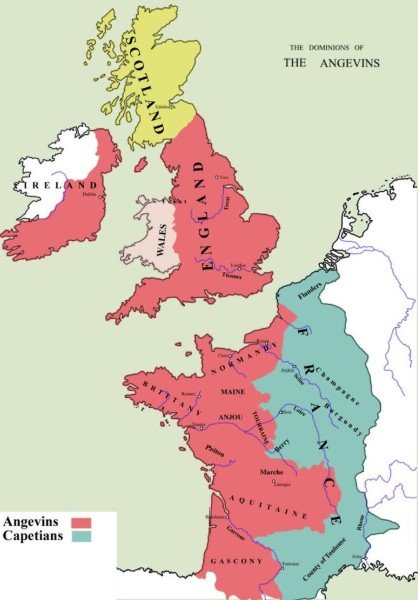
The people fascinated me first, but following their stories also began opening up a much bigger world. The Plantagenets may have ruled England, but their lives were never confined to it. Their lands, families, ambitions and conflicts stretched across borders, and the further I followed them, the more expansive their world became.
France is woven through their story from the very beginning. Eleanor brought Aquitaine into her marriage to Henry II, their sons moved constantly between territories on both sides of the Channel, and for generations the relationship between England and France shaped marriages, loyalties, wars and ultimately the fortunes of the dynasty itself. But even that is only part of the picture.
Follow Richard the Lionheart and suddenly the story stretches across Europe and into the Holy Land. Follow marriage alliances and daughters sent to foreign courts, and you find Plantagenet connections reaching into kingdoms across Europe. Trade created its own network of relationships, while diplomacy and war sent kings and their representatives searching far beyond their own borders for allies, money and influence.
I think that is another reason I have never tired of exploring their history. You can begin with one person in an English castle and find yourself following a trail across medieval Europe, discovering how connected their world really was. Every new path seems to lead somewhere else, and inevitably to another story I want to understand.
And perhaps that is also why visiting the places connected with them became so important to me. Reading their stories gave me the people, but travelling through their world added another dimension entirely.
And I’m Still Curious
More than twenty years have passed since I picked up The Sunne in Splendour from my sister’s bookshelf, and I sometimes wonder what I would have thought if someone had told me then where that book would eventually lead.
The wonderful thing is that I still don't feel as though I've reached the end of the story. There are people I know well whose actions I continue to question, others I have barely begun to understand, and places connected with their lives that I haven't yet seen. Every time I think I know a particular story, another detail appears that sends me off in a completely different direction.
Perhaps that is the real reason I chose the Plantagenets. They have never stopped making me curious.
And if you'd like to know what happened when that curiosity eventually became something much bigger, you can read the story of how Plantagenet Discoveries began here.
Fontevraude Abbey photo © Plantagenet Discoveries