Mont Saint-Michel - Faith, Fortification and the Plantagenets
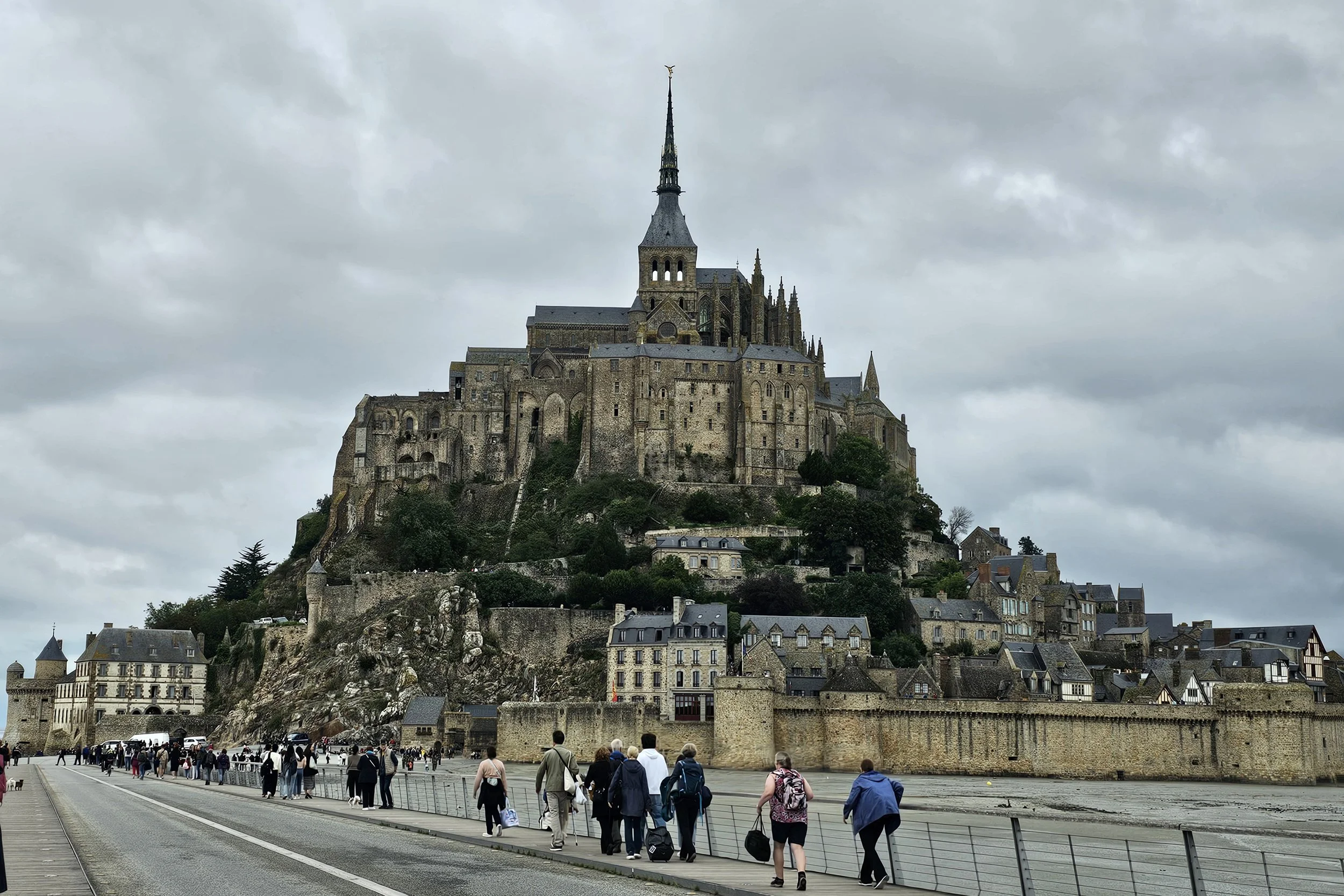
As we approached along the road, our jaws slowly dropped. Ahead of us, rising from the wide sweep of sand and sky, stood a place that seemed almost unreal, as though it belonged as much to legend as it did to history.
But the real magic happened as we left the road behind and began the final approach across the causeway. Whether arriving by shuttle or on foot, the ancient walls draw closer until you pass through the gate and enter a place that has welcomed pilgrims, soldiers, and travellers for more than a thousand years.
Read on to discover one of France’s most incredible places, where faith, resilience, and history have stood together for centuries.
As the Landscape Reveals Its Treasure
There is a moment on the journey across the Normandy countryside when the landscape begins to change. The fields stretch wider, the sky seems to open, and the land itself feels almost impossibly flat. Then, almost without warning, a shape begins to rise in the distance.
At first it is little more than a silhouette on the horizon, so unexpected that you almost question what you are seeing. But as the road continues and the coach draws closer, the outline becomes unmistakable. Towers emerge. Walls take shape. And above it all, the abbey rises skyward as though the rock itself has been reaching for heaven.
Even from a distance, the effect is extraordinary. It feels less like arriving at a monument and more like witnessing the landscape reveal something it has been quietly holding for centuries. I had seen it before, of course. On my earlier scouting trip, I had been on that very same road, albeit in a car rather than a coach, and taking in that first extraordinary view. This time I expected that my attention would be on my guests, excited to watch their reactions as the Mont slowly revealed itself. But the honest truth is, I found myself just as spellbound. It was a quiet realisation that the wonder of this place does not fade with familiarity.
Long before you step onto the causeway or pass through the ancient gates, Mont Saint-Michel has already begun to work its quiet magic.
Crossing the Causeway
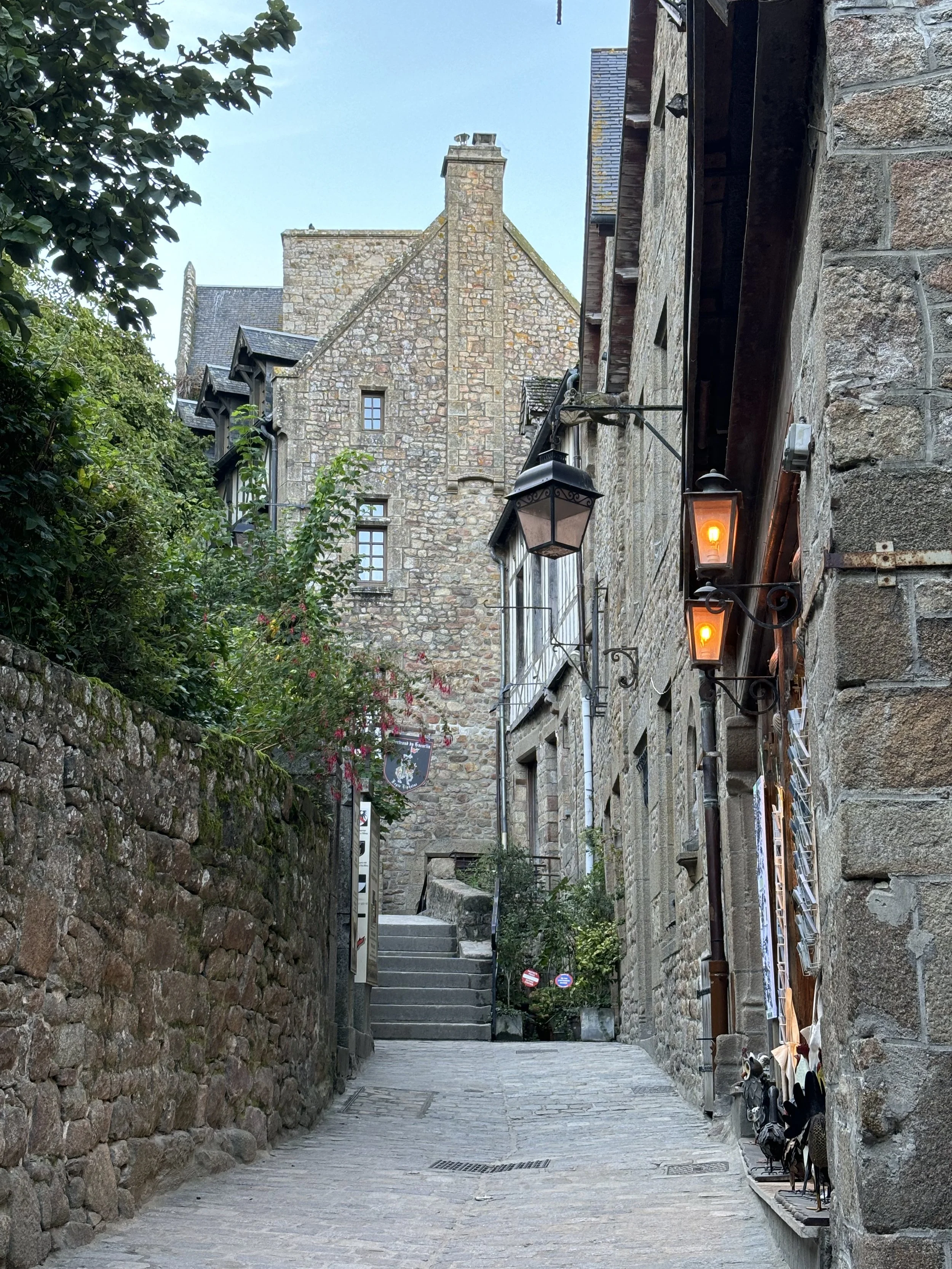
Entering the Mont feels like stepping across a threshold in time. The great stone walls rise around you, worn smooth in places by centuries of hands and weather, and suddenly you find you are no longer simply visiting, but part of a place that feels both ancient and alive.
Almost immediately the narrow streets begin to climb. Cobbled underfoot and lined with tall medieval buildings that lean close together, the lanes twist upward, guiding you toward something just out of sight, something mysterious. Little alleyways appear between doorways, staircases rise unexpectedly around corners, and everywhere there is stone, worn smooth by the countless souls who, over the centuries, were drawn here by faith.
And yet the Mont is far from silent. Voices drift through the streets, footsteps echo on the cobbles, and visitors pause often, looking upward toward the abbey that seems to watch over it all. The place hums with life and movement, much as it would have done when pilgrims once arrived here after long journeys across Normandy.
Even so, beneath the bustle there is something else, something harder to explain. A sense that you are walking through layers of time, where faith, defence, and daily life once intertwined within these narrow streets.
Drawn by Faith
Today we visit Mont Saint-Michel as tourists, snapping photos and marvelling that sites like this have stood for centuries. However, during the Middle Ages, people came here not simply to visit, but because they believed they were being called. Pilgrimage in the medieval world was far more than travel. It was an act of devotion, sometimes undertaken in hope of healing, sometimes in gratitude, and just as often, as an act of penance. Men and women from across France, England, and beyond would set out on long and often difficult journeys, driven by the belief that certain places held a spiritual significance unlike any other.
And this tiny island off the coast of Normandy was one of those places…
Long before the modern causeway was built, reaching the island was far from straightforward. Pilgrims approaching Mont Saint-Michel had to cross the wide tidal flats that stretch across the bay, a landscape that could shift from firm sand to rushing water with startling speed. To accomplish this themselves was extremely dangerous so travellers were often dependent upon experienced guides who knew the safest routes across the sands and the rhythms of the tides. However, misjudge the timing, and the rising waters could very quickly turn the journey into something far more perilous than pilgrims had originally anticipated.
The reason for its popularity as a pilgrimage site lies in a story that has shaped this island for more than a thousand years. According to tradition, in the early eighth century the Archangel Michael appeared to Aubert, the Bishop of Avranches, instructing him to build a sanctuary on the rocky outcrop rising from the tidal bay. At first Aubert hesitated, unsure whether the vision was truly divine. But the story goes that the archangel appeared again, and then a third time, until the bishop began to realise that the command should not be ignored.
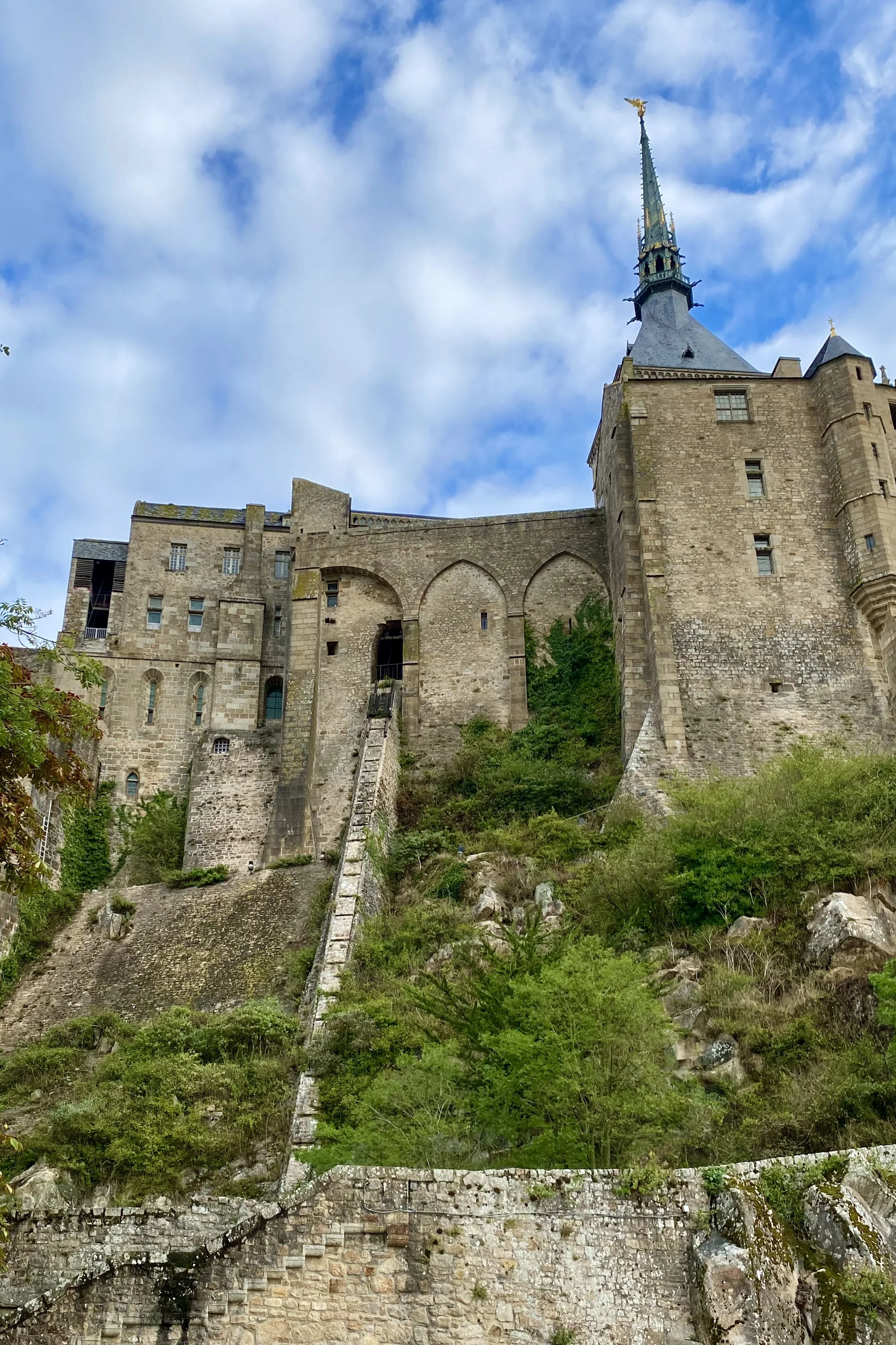
Eventually responding to what he believed was a divine command, in 708 he established a small sanctuary dedicated to Saint Michael on the rocky summit. What began as a modest place of worship soon drew increasing numbers of pilgrims, eager to honour the archangel who, in Christian belief, was seen as both protector and guide of souls. Over the centuries that followed, the sanctuary gradually grew. Monks settled on the island in the tenth century, and successive generations expanded the buildings into the remarkable abbey complex that now crowns the summit. Rising tier upon tier above the village streets, the abbey became both a spiritual beacon and a symbol of devotion visible from miles across the tidal bay.
While the abbey dominates the skyline and draws the eye upward from almost every corner of the island, there is another place of worship on the Mont that is far easier to overlook.
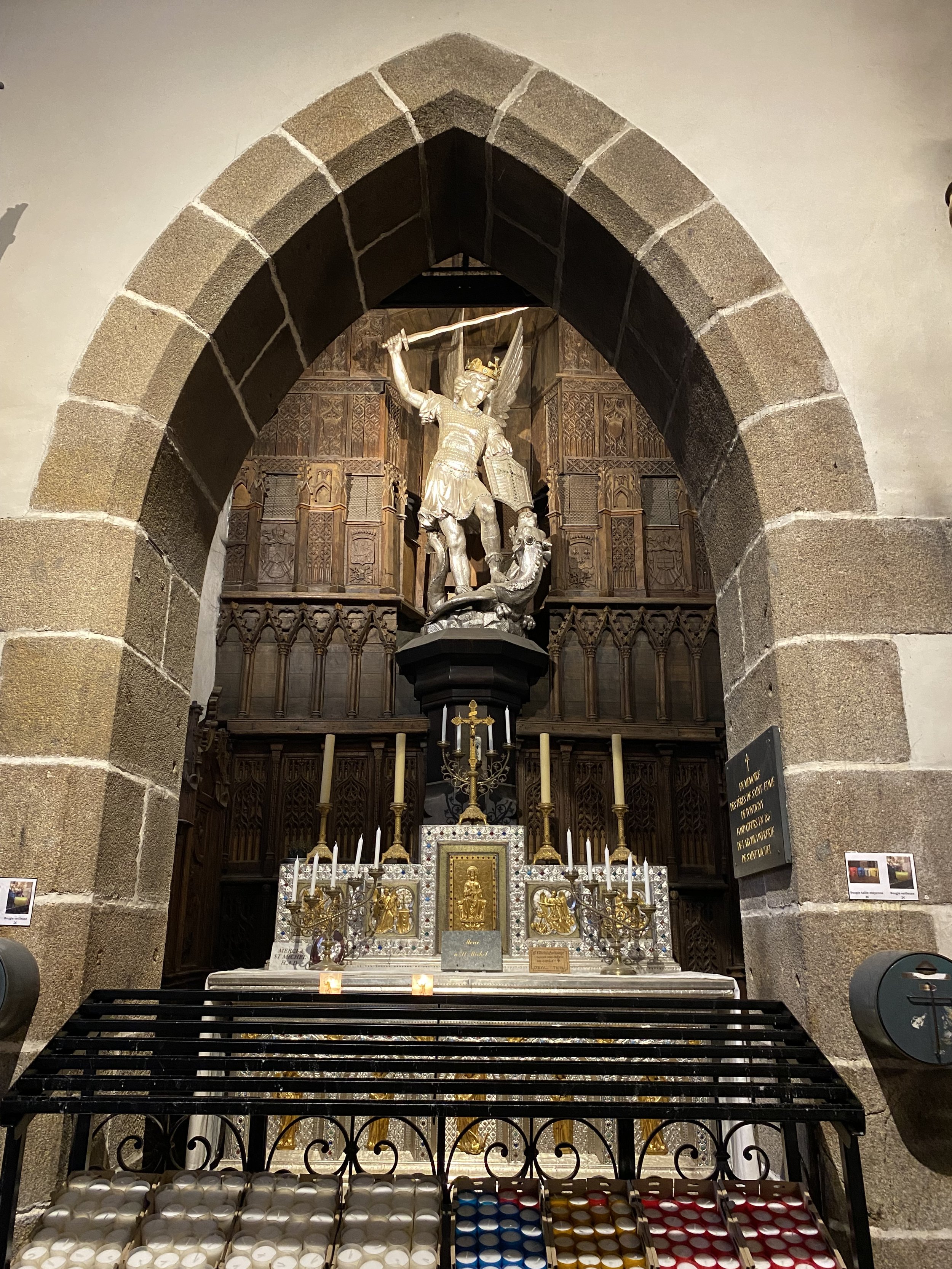
Tucked among the narrow streets stands the parish church of Saint-Pierre. Smaller and far less imposing than the great abbey above, it nevertheless holds a quiet beauty of its own. Inside, the soft glow of candles surrounds a striking statue of Saint Michael, sword raised in triumph over the dragon beneath his feet. It is a peaceful place to pause for a moment of reflection, and on both of my visits I found myself returning more than once, drawn by the calm and relative silence that can be hard to find elsewhere on the island.
Mont Saint-Michel in the Age of the Plantagenets
The year 1154 marked an important moment on both sides of the Channel. In England, Henry II ascended the throne, establishing what would become the Plantagenet dynasty. In that very same year, Robert of Torigni became abbot of Mont Saint-Michel. A respected scholar and chronicler, Robert would go on to record many of the events of the twelfth century, leaving behind one of the most valuable historical accounts of the age. From his abbey on this rocky island, he observed and documented a world that included the early reign of Henry II and the growing influence of the Plantagenet kings.
During his years as abbot, Robert of Torigni became known not only as a leader of the abbey but also as one of the great historians of his age. His chronicles recorded events across Normandy and England, preserving valuable insight into the turbulent political world of the twelfth century. Henry II himself visited Mont Saint-Michel during Robert’s abbacy, a reminder that this island was connected not only to pilgrims and prayer, but also to the wider political life of the Plantagenet realm. Robert remained at the abbey for more than thirty years, and when he died in 1186 he was buried here on the Mont, the island that had been both his home and the place from which he quietly recorded the history of his time.
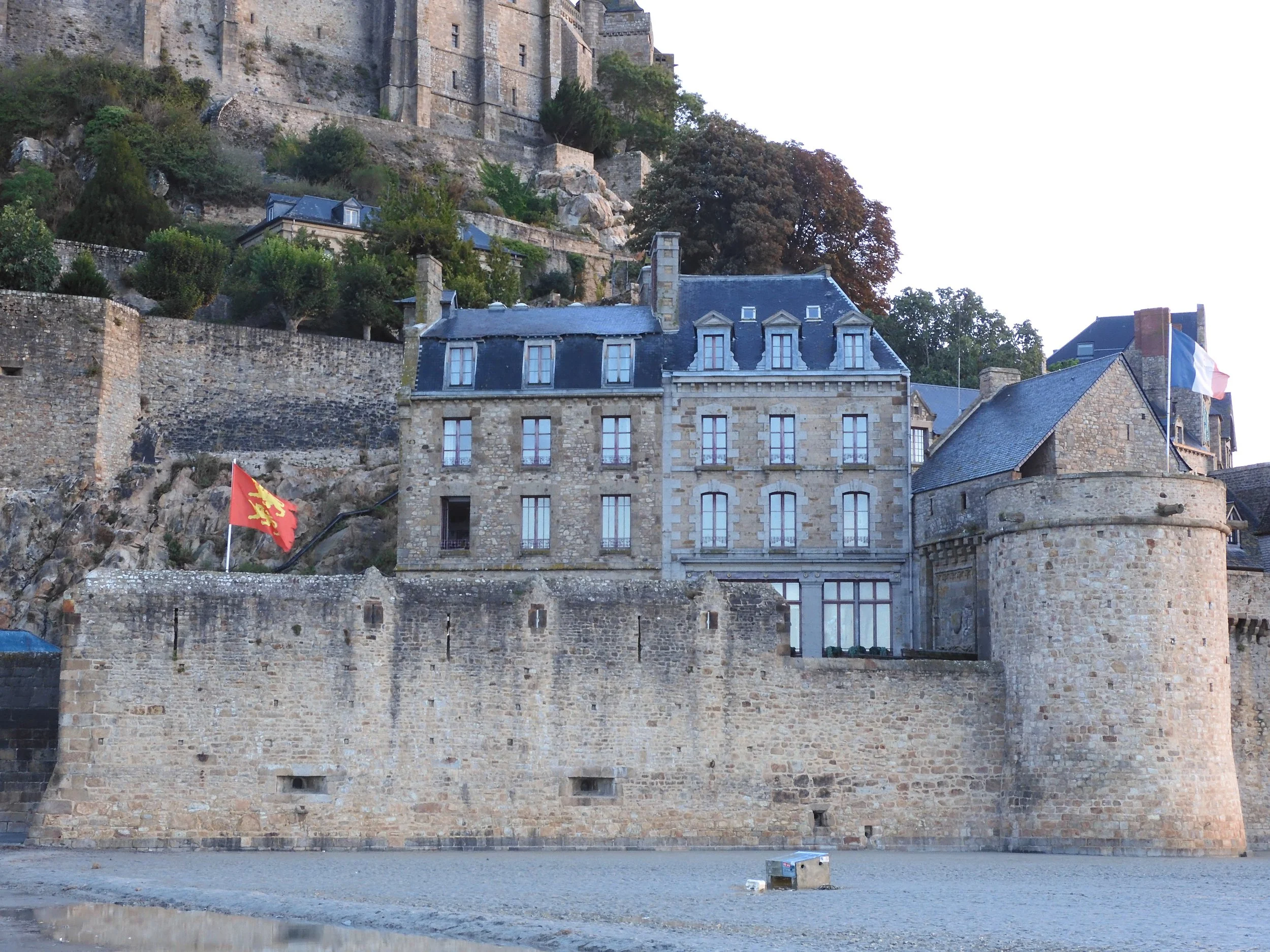
So while the early Plantagenet years were relatively peaceful for the island, moving forward more than two centuries later to the early 15th century, we find the story of Mont Saint-Michel takes a very different turn.
As the long conflict between England and France unfolded during the Hundred Years’ War, Normandy became a battleground, and one by one the great towns and fortresses of the region fell into English hands. Yet this small rocky island, rising from the tidal bay and crowned by its abbey, proved far more difficult to conquer than many had imagined, not least of all the English themselves.
The island’s natural defences played a crucial role in its survival. Surrounded by wide tidal flats that could transform rapidly with the rising sea, the Mont was well isolated, even in times of peace.
During the war its walls were strengthened, and a small but determined garrison stood ready to defend the island. The French captain Louis d’Estouteville became one of the key figures in this defence, overseeing the protection of the Mont for many years as English forces attempted to break its resistance.
One of the most determined attacks came in the 1430s, when English forces led by Thomas Scales, 7th Baron Scales, attempted to capture the island by force. Yet despite their efforts, the defenders held firm. The tides, the fortified walls, and the determination of those defending the Mont combined to repel the assault. Two large English bombards were captured during the fighting, and they can still be seen today outside the entrance to the island, silent reminders of a time when Mont Saint-Michel refused to yield.
When the Island Grows Quiet
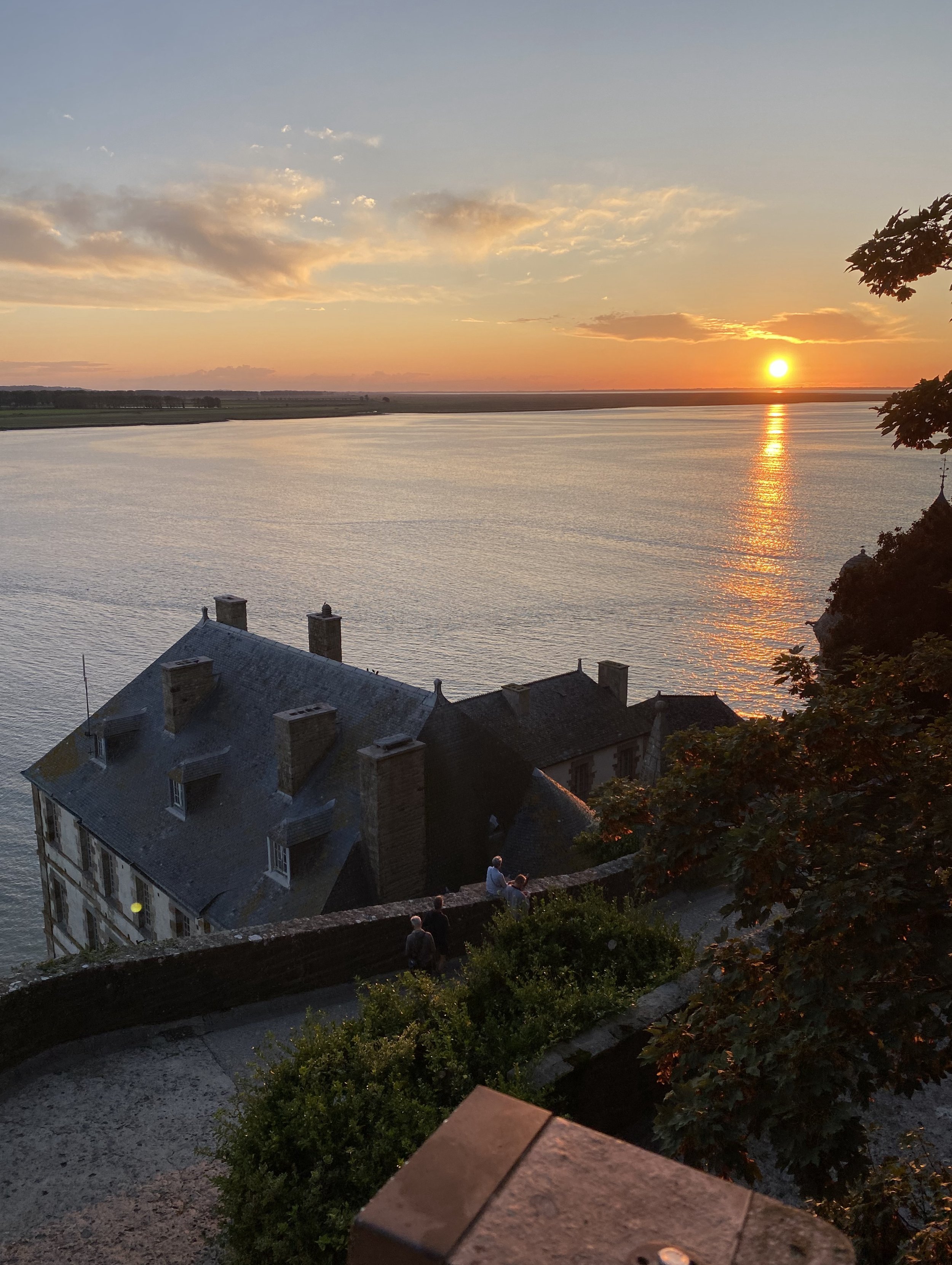
As the day draws to a close, Mont Saint-Michel begins to change. The crowds that filled the narrow streets throughout the afternoon gradually drift away, returning across the causeway to the mainland. What remains behind is something altogether different. The island grows quieter, the light softens, and the great abbey that dominated the skyline all day now seems to gently fall asleep. Standing on the walls and watching the sun sink slowly across the bay, it feels almost as though the Mont itself is preparing for rest, in rhythm with the fading light of the day.
That evening, after dinner, many of us wandered out again to watch the sunset. The view across the bay was magnificent, the sky turning shades of gold and amber as the light slipped slowly toward the horizon. It was one of those rare moments where everything seems perfectly balanced. The island, the sea, the sky, all moving together toward the quiet of night. For me, there was also a quiet sense of completion. As a tour host, there is always a small moment of reflection at the end of the day, a feeling of satisfaction when everything has unfolded as hoped. Watching the sunset from the walls of this extraordinary UNESCO World Heritage site, it felt very much like the beautiful closing of a perfect chapter in our journey.
There was another small moment that made our overnight stay even more special for me. Our guide Ange, who has spent decades guiding visitors through Normandy and Paris, mentioned that despite bringing groups to Mont Saint-Michel many many times over the years, he had never actually stayed overnight on the island before. Like so many visitors, his groups had always arrived with the crowds and left again before nightfall. Experiencing the Mont after the day visitors had gone was something entirely new for him as well, and I was super excited to have been able to give him that opportunity.
After an incredible sleep with my dreams surrounded by history, I discovered that the morning brings with it an entirely different feeling. When the island wakes, it does so slowly and quietly. Before the first visitors arrive, the streets belong only to a handful of early risers, the occasional delivery vehicle, and those who have chosen to stay overnight on the Mont. Looking out across the bay in the early light, despite being able to clearly see the mainland visible in the distance, there is this surprising sense of separation from the rest of the world. It feels almost like waking up in a place that exists in its own time and space.
We rose early that morning and wandered through the streets before breakfast, cameras in hand, enjoying the rare stillness of the island. The Mont that had felt so lively and energetic the day before now felt calm and reflective. It was a completely different experience, and yet in its own way, just as memorable. In those quiet morning moments, it was easy to imagine how the island might have felt centuries ago, when pilgrims arrived after long journeys and found themselves standing in a place that seemed set apart from the world beyond the bay.
As we eventually made our way back to our rooms to pack up and head down for breakfast, the island slowly began to stir to life again, and I found myself reflecting on how different the Mont had felt in those quiet moments. The evening had carried a sense of completion, as though the island itself was settling into rest after the energy of the day. Yet the morning brought something entirely different, a feeling of renewal, of a place quietly awakening to begin the story again. Perhaps that is part of what makes Mont Saint-Michel so special. It is not simply a place you visit for a few hours before moving on. It is a place that invites you to pause, to breathe, and to experience its different rhythms in a way that lingers long after you leave.
Experiencing places like Mont Saint-Michel in this way is one of the things I love most about hosting small group journeys through the historic landscapes of France and England. When we slow down and allow time for these quieter moments, history becomes so much more than a story we read about. It becomes something we feel.
If you would like to learn more about the journeys we take through these remarkable places, you can explore upcoming tours below.
Explore our tours
Images: All Mont Saint-Michel Images © Plantagenet Discoveries