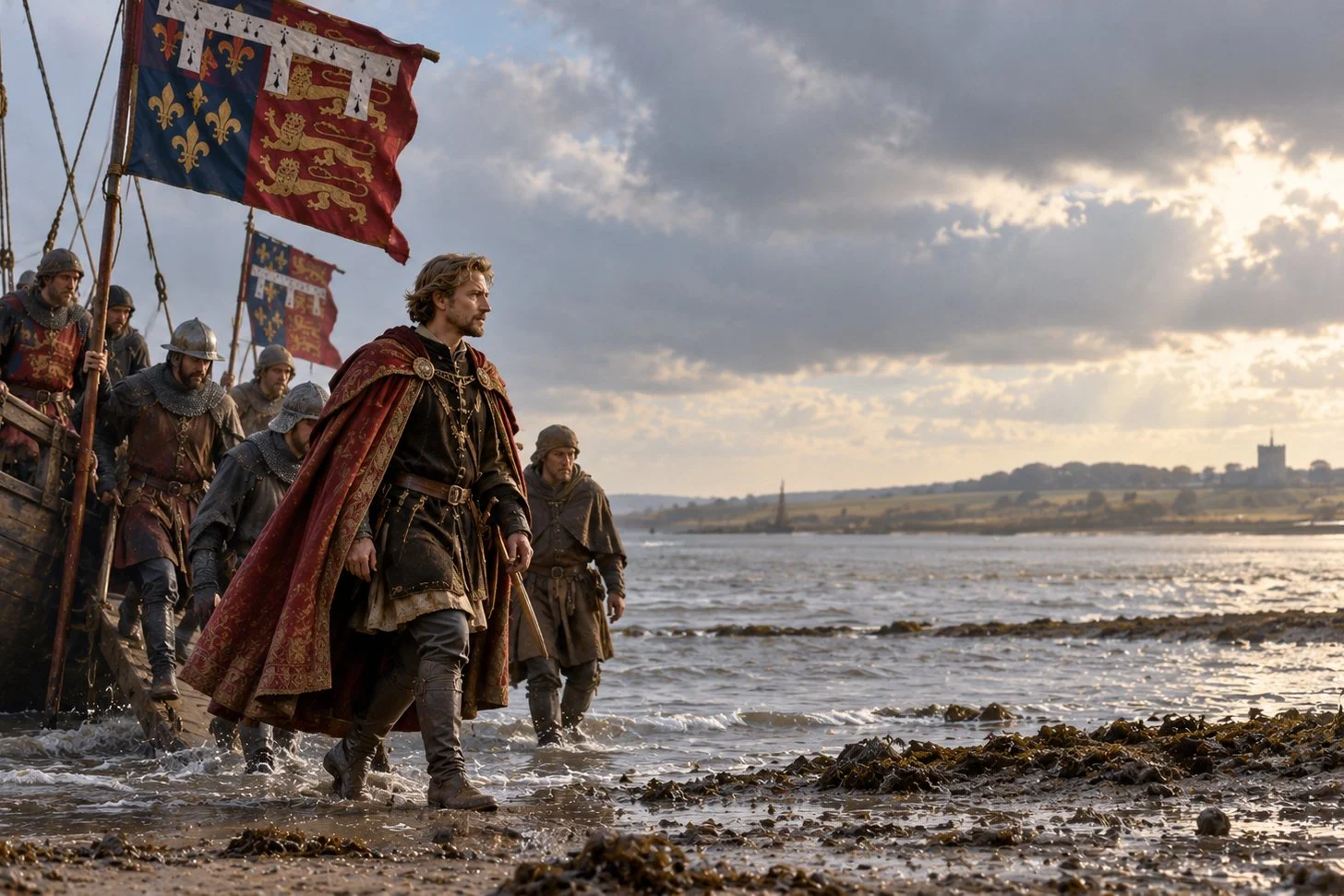
As the fourteenth century drew to a close, Henry Bolingbroke was in exile, not only grieving the loss of his father, but stripped of the inheritance that should have secured his family's future.
Across the Channel, he could only watch as Richard II tightened his grip on England, seemingly unaware of the resentment gathering around him. A man of Bolingbroke's standing was never going to remain quietly dispossessed. The question was what would happen when he finally returned. The events of 1399 would set England on a course that few could have imagined, with consequences that would reach far beyond the lives of the two cousins at the centre of the unfolding drama.
Bolingbroke Returns
In the summer of 1399, Henry Bolingbroke faced a deeply uncertain future. His father, John of Gaunt, had died in February, and the vast Lancastrian inheritance that should have passed to him had been confiscated by his cousin, Richard II. Already banished from England following his dispute with Thomas Mowbray, Bolingbroke now faced a lifetime in exile, deprived of the lands, income and influence that had sustained his family for generations. For a man raised with the expectation of inheriting his father's position, Richard's decision was an extraordinary humiliation, and one that threatened the future of the House of Lancaster.
Richard, meanwhile, had turned his attention towards Ireland, where renewed unrest required his presence. In May 1399, he sailed across the Irish Sea with a substantial military force, leaving his uncle, Edmund of Langley, Duke of York, to oversee affairs in England. His absence presented Bolingbroke with an opportunity, particularly as resentment towards Richard's increasingly authoritarian rule had been growing among the nobility. The confiscation of the Lancastrian estates had raised troubling questions about the security of noble inheritance, and many powerful families were beginning to wonder whether their own lands and privileges might one day be threatened.
In early July, Bolingbroke crossed the Channel with a relatively small group of supporters, including Thomas Arundel, the exiled Archbishop of Canterbury, and landed near Ravenspur on the Yorkshire coast. His declared purpose was to recover his rightful inheritance, a claim that resonated with those who believed Richard had overstepped the traditional limits of royal authority. News of his arrival spread quickly, and among those who rallied to his cause were Henry Percy, Earl of Northumberland, and his son, Harry Hotspur. Their considerable influence in northern England gave Bolingbroke's campaign both military strength and political credibility, while others joined for reasons ranging from loyalty to the Lancastrian family to dissatisfaction with Richard's government.
As Bolingbroke moved south, his following continued to grow, leaving the Duke of York in an increasingly difficult position. Although he owed allegiance to Richard, Bolingbroke was also his nephew, and York struggled to organise effective resistance as support for the returning exile gathered momentum. By the end of July, he had reached an accommodation with Bolingbroke, effectively removing one of the last significant obstacles to his advance.
For Richard, still in Ireland, the news could scarcely have arrived at a worse moment. Communications across the Irish Sea were slow, and by the time he understood the seriousness of the situation, Bolingbroke had already gained considerable ground. What had begun as an attempt to reclaim a confiscated inheritance was rapidly developing into a far greater challenge to royal authority, and as Richard prepared to return to England, the future of his kingship was becoming increasingly uncertain.
The Fall of Richard II
When Richard II finally returned from Ireland in July 1399, he discovered that the England he had left only weeks earlier had changed dramatically. Bolingbroke's supporters had multiplied, royal authority was crumbling, and several of the men Richard had trusted to defend his interests had either been captured or abandoned his cause. Landing in Wales, Richard initially hoped to gather an army capable of resisting his cousin, but those hopes quickly faded as his remaining supporters dispersed. He withdrew to Conwy Castle, where the reality of his increasingly desperate position became impossible to ignore.
Henry Percy, Earl of Northumberland, was sent to negotiate with Richard, reportedly offering assurances that Bolingbroke sought only the restoration of his inheritance and that the king would retain his crown.
Richard eventually agreed to leave Conwy, but the circumstances of his departure remain controversial. Some contemporary accounts suggest that Northumberland used deception to secure his cooperation, and by the time Richard reached Flint Castle, he was effectively in Bolingbroke's custody. Their meeting at Flint in August 1399 marked an extraordinary reversal of fortune. The king who had banished his cousin and confiscated his inheritance now found himself powerless before the very man he had attempted to exclude from English political life.
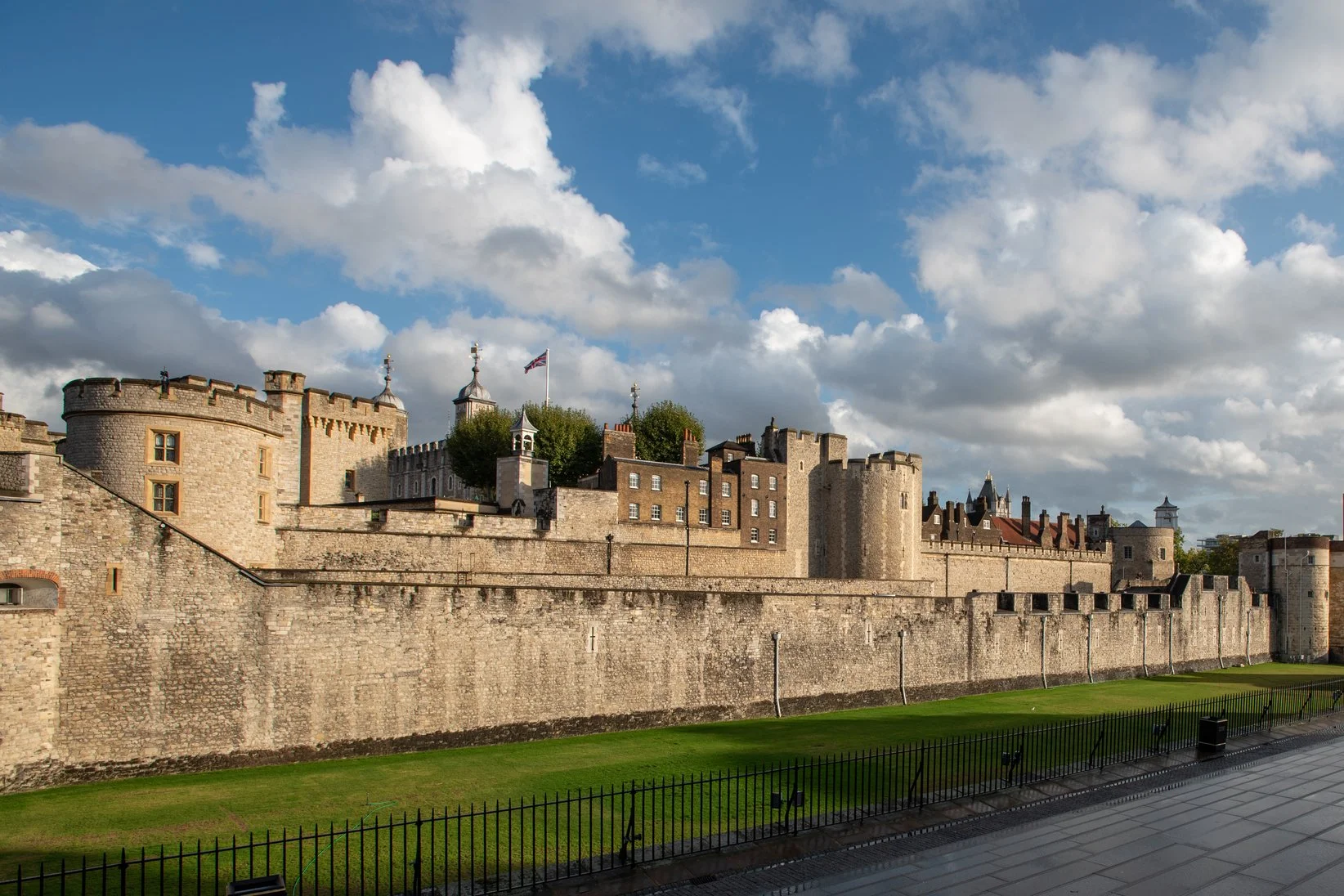
Richard was taken south under guard, eventually arriving in London, where he was confined in the Tower of London. By this stage, Bolingbroke's ambitions had moved far beyond recovering his father's estates, and preparations were underway to remove Richard from the throne. On 29 September, a formal account recorded Richard's renunciation of the crown, presenting his decision as voluntary. The following day, an assembly at Westminster accepted his resignation and approved a series of accusations against his government, formally declaring him deposed.
Yet whether Richard truly abdicated of his own free will remains a subject of considerable historical debate. The official proceedings portrayed him as acknowledging his failures and willingly surrendering his royal authority, but these records were produced under the direction of those who stood to benefit from his removal. Richard was a prisoner, deprived of meaningful political support and surrounded by men who had already determined that his reign should end. Under such circumstances, how much freedom did he really possess to refuse? The formal deposition also raises an intriguing question: if Richard had genuinely surrendered his crown voluntarily, why was it necessary to declare him unfit to rule?
For Bolingbroke and his supporters, establishing a lawful justification for Richard's removal was essential. An anointed king was understood to hold his authority through divine sanction, and removing him challenged principles that had underpinned English monarchy for generations. The proceedings of September 1399 attempted to resolve that difficulty by presenting Richard's departure as both a voluntary renunciation and a justified deposition.
Richard's reign had ended, but the questions surrounding his removal would prove far more difficult to settle. England now faced the unprecedented challenge of accepting a new king while its former monarch remained alive, and the consequences of that decision would cast a long shadow over the years ahead.
A Crown with Questions
With Richard II removed from the throne, Henry Bolingbroke faced a challenge that could not be resolved through military strength alone. He needed to establish why he, rather than another member of the royal family, should become England's next king. As the son of John of Gaunt and grandson of Edward III, Henry possessed an impressive royal pedigree, but his hereditary claim was far from straightforward. Edward III had left several sons whose descendants could claim a place in the succession, and the question of who held the strongest right to the crown was considerably more complicated than Henry's supporters might have wished.
By the principle of inheritance through the senior family line, the claim of the young Edmund Mortimer, Earl of March, was arguably stronger. Edmund was descended from Lionel of Antwerp, Edward III's second surviving son, through Lionel's daughter Philippa, while Henry descended from Edward's third surviving son, John of Gaunt. Although Edmund was still a child, his existence presented an uncomfortable problem for Henry. The English crown had passed through the male line for generations, but there was no universally accepted rule excluding inheritance through a woman, and the Mortimer claim could not simply be dismissed.
On 30 September 1399, Henry presented his claim before the assembled lords and commons at Westminster, invoking his royal ancestry and his right to recover a kingdom that had suffered under Richard's government. His declaration drew upon several arguments rather than relying solely upon hereditary succession. He was a descendant of Henry III, he had returned to recover his rightful inheritance, and, perhaps most importantly, he had demonstrated that he possessed the support necessary to govern. The assembly accepted his claim, and Henry Bolingbroke became Henry IV, establishing the Lancastrian branch of the Plantagenet family upon the English throne.
His coronation took place at Westminster Abbey on 13 October 1399, the feast day of Edward the Confessor. The ceremony followed the traditions of English kingship, with Henry receiving the sacred anointing that symbolised the divine authority of the monarch. It was an occasion intended to demonstrate continuity and legitimacy, reassuring the kingdom that the familiar institutions of monarchy would endure despite the extraordinary circumstances of Richard's removal. Yet the ceremony also carried an unavoidable contradiction. Richard II had received that same sacred anointing at his own coronation in 1377, and he was still alive.
Henry had gained the crown through a combination of hereditary connection, political support and the removal of his predecessor, but none of these entirely settled the question of his right to rule. His supporters might regard him as the man who had rescued England from Richard's misgovernment, while others could reasonably wonder whether the events of 1399 had established a dangerous precedent. If an anointed king could be removed because his subjects considered his rule unacceptable, what protection did the same principle offer his successor?
For Henry IV, the challenge was now to turn a contested accession into an enduring kingship. The crown was his, but the loyalty of those who had helped him obtain it would soon be tested, and the questions surrounding his legitimacy would continue to influence the course of his reign.
The Price of Kingship
Henry IV had barely settled upon his throne when the first serious attempt to overthrow him began taking shape. Although Richard II was imprisoned, he remained a powerful symbol for those who regarded Henry as a usurper. Among Richard's former supporters were several nobles who had lost titles and influence following the change of king, including his half-brother John Holland, Earl of Huntingdon, and John's nephew Thomas Holland, Earl of Kent. Their grievances were both political and personal, and by the closing weeks of 1399, a conspiracy was gathering momentum.
The plot, which became known as the Epiphany Rising, centred upon a plan to seize or kill Henry during the Twelfth Night celebrations at Windsor in January 1400, then release Richard and restore him to the throne. However, Henry received warning of the conspiracy and withdrew to London before the attack could take place. With their plans exposed, the conspirators attempted to raise support in the countryside, but the rebellion quickly unravelled. Several of its leaders were captured and executed, including both Holland earls, while others met similarly violent ends.

The rising demonstrated just how fragile Henry's position remained. Despite his coronation and the formal proceedings that had removed Richard, there were still men willing to risk their lives to restore the former king. As long as Richard remained alive, he offered a focus for opposition, whether or not he had any realistic prospect of regaining his crown.
In February 1400, Richard died while imprisoned at Pontefract Castle. The precise circumstances of his death remain uncertain. The traditional account suggests that he was deliberately starved, although some historians have considered whether he may have refused food himself. There is no conclusive evidence establishing exactly what happened, nor can Henry's personal responsibility for Richard's death be determined with certainty. What is clear is that Richard's death removed the most obvious figure around whom Henry's enemies might unite.
Richard's body was subsequently displayed publicly to demonstrate that he was dead, before being buried at King's Langley. Yet his death did little to silence the questions surrounding Henry's accession. Rumours that Richard had survived would circulate for years, while resentment towards the new king continued to grow in other parts of the kingdom. Henry had survived his first rebellion, but the struggle to secure his crown was only beginning.
Rebellion Across the Kingdom
The Epiphany Rising had been defeated, but Henry IV's troubles were far from over. In September 1400, Owain Glyndŵr, a Welsh landowner whose dispute with the English nobleman Lord Grey of Ruthin had become entangled with wider grievances, was proclaimed Prince of Wales by his supporters. What began as a regional uprising developed into a prolonged rebellion against English rule, drawing strength from resentment over political exclusion, restrictive laws and the treatment of the Welsh population. Henry led several campaigns into Wales, but difficult terrain, elusive opponents and the growing support for Glyndŵr made a decisive victory impossible.
Meanwhile, Henry's relationship with the powerful Percy family was deteriorating. Henry Percy, Earl of Northumberland, and his son, Harry Hotspur, had played important roles in Bolingbroke's return from exile, providing the military support that helped secure his accession. Yet disagreements over money, royal rewards, authority in the north and the handling of Scottish prisoners gradually undermined their alliance. Hotspur became increasingly disillusioned with the king, and in 1403 the Percys turned against the monarch they had helped place upon the throne.
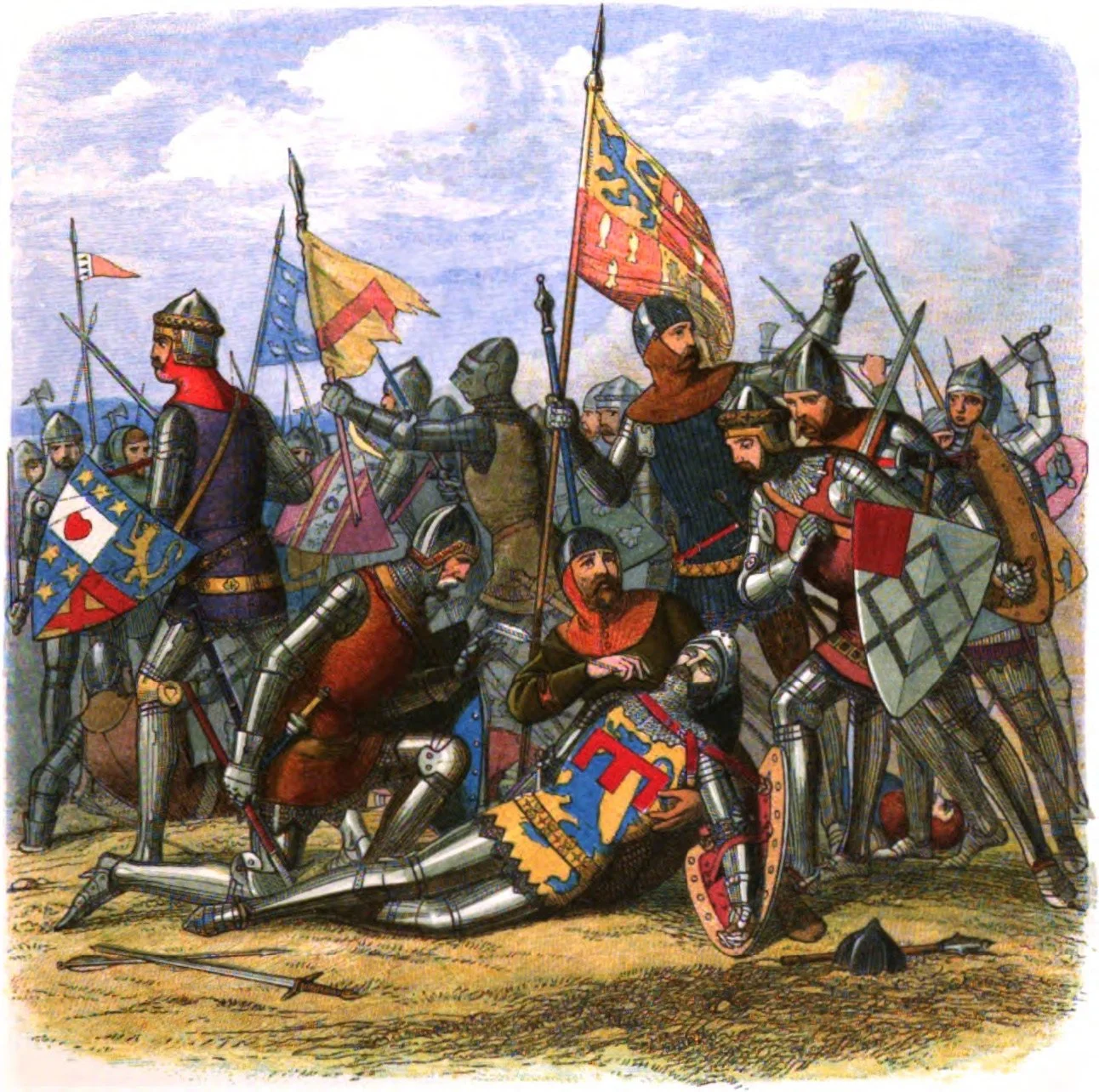
The confrontation came finally came to a head at the Battle of Shrewsbury on 21 July 1403, when Henry's forces met an army led by Hotspur. It was a fiercely contested engagement, made all the more dangerous by the presence of the king's eldest son, Prince Henry, who was seriously wounded in the face by an arrow but survived. Hotspur was killed during the fighting, leading to the collapse of the rebel army. Although the king had secured an important victory, the battle revealed how readily former allies could become enemies when expectations of royal favour and political influence were disappointed.
And the threat certainly did not disappear with Hotspur's death. Northumberland remained a constant source of opposition, while Glyndŵr continued to resist English authority in Wales. In 1405, the rebellion widened when Glyndŵr joined forces with Edmund Mortimer, whose family possessed a rival claim to the English throne, and Northumberland. Their agreement envisaged dividing England and Wales into separate spheres of control, a remarkable indication of how seriously Henry's enemies challenged the existing political order. The proposed alliance ultimately failed to achieve its ambitions, but Glyndŵr's resistance continued for years, and Northumberland was not finally defeated until 1408, when he was killed at the Battle of Bramham Moor.
For much of his reign, Henry was forced to devote enormous resources to defending his authority. Repeated military campaigns placed heavy demands upon royal finances, while the need to secure funds from parliament made him increasingly dependent on cooperation from the political community. By the time the major rebellions had been contained, Henry had demonstrated his determination to retain the crown, but the effort had taken a considerable toll upon both the kingdom and its king.
The Final Years of Henry IV
By the closing years of his reign, Henry IV had survived the rebellions that threatened his crown, but his health was increasingly failing him. From around 1405, he suffered recurring bouts of serious illness, the precise nature of which remains uncertain. Contemporary accounts described debilitating attacks that sometimes left him unable to attend to the affairs of government, and as his condition worsened, greater responsibility gradually passed to his eldest son, Prince Henry, who had already distinguished himself through his military service in Wales.
The prince had become an increasingly influential figure in royal government, particularly during the years when his father's health prevented him from exercising full authority. Yet their relationship was not without tension. Differences emerged over political appointments, the direction of royal policy and the influence of competing advisers. In 1411, Prince Henry and his supporters lost much of their influence on the royal council, although the extent of any personal estrangement between father and son remains uncertain. Despite these disagreements, there was little doubt about the succession. Unlike his own accession in 1399, Henry IV's eldest son stood ready to inherit the crown through an established line of descent.
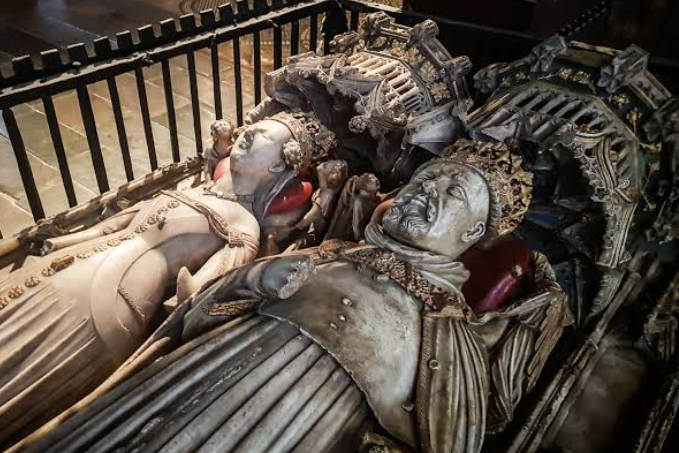
On 20 March 1413, Henry IV died in the Jerusalem Chamber at Westminster Abbey, aged forty-five. His body was taken to Canterbury Cathedral for burial, an unusual choice for an English king, but one associated with his particular devotion to Thomas Becket. After nearly fourteen years upon the throne, the man who had returned from exile to reclaim his inheritance left behind a dynasty that had survived repeated challenges to its authority.
Henry's reign had been dominated by the consequences of the extraordinary events of 1399. He had secured the crown and passed it to his son, yet the questions surrounding Richard II's removal and the competing claims of the Plantagenet family had never been entirely resolved. Those uncertainties would endure long after Henry's death, shaping the struggles of later generations. For now, however, England had a new king, and the young Henry V would soon turn the kingdom's attention towards France.
Henry V inherited a crown still shadowed by the events of 1399, but his ambitions would soon take England in a very different direction, across the Channel and towards the French throne.
In our next instalment, we follow Henry V as he sets out to claim a kingdom, and discover how his ambitions would lead to one of the most celebrated victories in English medieval history.
If you would like to explore the castles, cathedrals and battlefields where the Plantagenet story unfolded, I'd love you to join us on one of our small-group historical tours through England and France.
Explore our tours
Images: Henry Bolingbroke’s Landing at Ravenspur (AI-generated image); Tower of London, Pontefract Dungeon, Henry IV tomb at Canterbury (© Plantagenet Discoveries); James William Doyle painting of the Death of Henry Hotspur (Public Domain)