Arthurian Trilogy by Giles Kristian
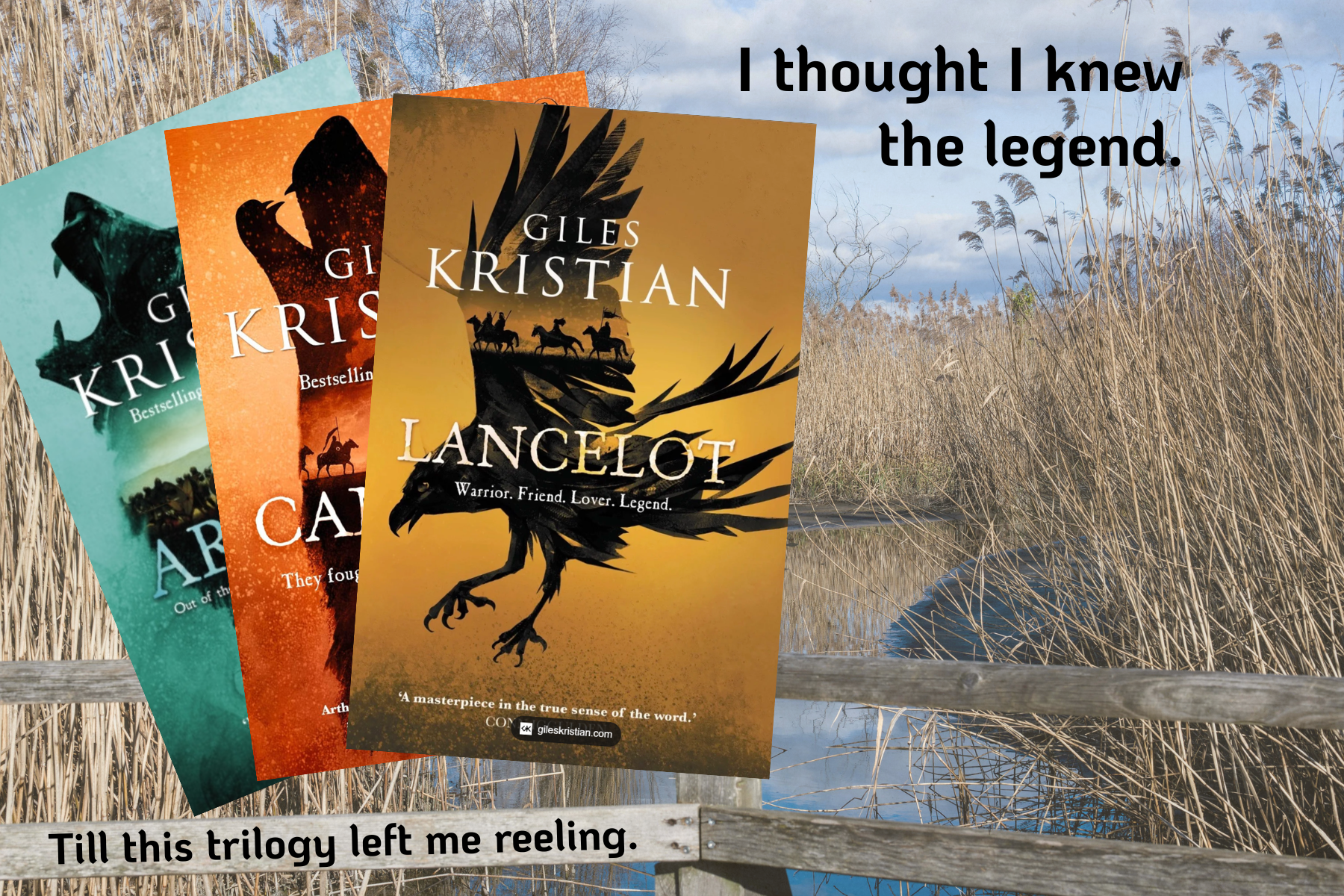
I thought I knew the Arthurian legend. I simply wasn't prepared for where Giles Kristian would take it.
I have read a lot of Arthurian fiction over the years, so I don't say this lightly. Across Lancelot, Camelot and Arthur, Giles took characters and stories in directions I never expected and created the best Arthur trilogy I have ever read.
I first came across Giles Kristian through his Viking novels. At the time I was up to my neck in Bernard Cornwell, with The Last Kingdom fuelling a fairly serious interest in all things Viking, and his books quickly became favourites of mine too. So when I spotted that he had written a novel about Lancelot, I was curious.
Lancelot seemed an unusual choice for the centre of an Arthurian novel. In so many of the versions I had read, and in the most well-known legend itself, he was the secondary character whose relationship with Guinevere helped bring about the destruction of Arthur's world. Giles actually did something I hadn't encountered before. He took me right back to Lancelot as a young boy, long before Arthur, Guinevere and the events I already knew were waiting somewhere ahead of him.
That decision to begin with Lancelot as a boy changed everything for me. I became emotionally invested in him very quickly, and as the years passed and that young boy became a man, I felt as though I had travelled through his life alongside him.
Of course, I knew the Arthurian legend. I knew about Lancelot and Guinevere, and I knew where that relationship would eventually lead. Yet knowing Lancelot from childhood changed the way I experienced those familiar events. He was no longer simply the knight whose choices would have devastating consequences for Arthur and those around him. He was someone I had watched grow up, someone I cared about, which meant I became ridiculously involved in every decision he made. There were moments when I was quite literally yelling at the audiobook in the car because someone had done something heartbreaking, infuriating or just plain stupid.
By the end of Lancelot, I felt as though Giles had introduced me to a character I had known for years and yet somehow allowed me to meet him for the first time.
When I eventually picked up Camelot, I was surprised to discover that Giles wasn't simply going to continue the story from where Lancelot had ended. Years have passed, and this time we meet Galahad, Lancelot's son, living among a community of monks and carrying some very complicated feelings about the father he believes abandoned him.
That immediately put me in an interesting position as a reader. I had spent an entire book getting to know and care about Lancelot, while Galahad viewed his father through the eyes of a child who had been left behind. I knew the man he was angry with in a way that Galahad never had the chance to, and there were times when I desperately wanted to reach into the book and tell him what I knew.
As Galahad is drawn out of the secluded world in which he has grown up, he finds a Britain still living with the consequences of Camlann. The old alliances have fractured, the Saxon threat is growing, and many of the people whose names belong to Arthur's story have either disappeared or become shadows of who they once were. Gradually, some very familiar faces begin to emerge, although rarely in quite the way I expected to find them.
At the heart of the story is a quest rooted in the old beliefs of Britain, and Giles once again takes elements of Arthurian legend that feel familiar and reshapes them into something distinctly his own. There are journeys through marshes, battles, old loyalties and new relationships, and I found myself constantly wondering which pieces of the legend he would draw upon next and what he was going to do with them.
For all that I enjoyed Camelot, it was probably the weakest of the three books for me. My biggest difficulty was Galahad himself. He has spent years living in a religious community, with very little opportunity to develop the skills of a warrior. Early in the story, Giles even shows us how inexperienced he is when confronted with the reality of fighting and killing.
Yet before long, Galahad seems remarkably capable in battle. I could accept that Lancelot had trained him when he was very young and that perhaps some natural ability had been inherited from his father, but the speed of that transformation never quite convinced me.
And then there was the title. Camelot. I kept waiting for the moment when I would understand why Giles had chosen it, and even after finishing the book, I wasn't entirely sure that I did. Perhaps other readers will see something in it that I missed, but it remained a slightly odd choice to me.
Neither of those things stopped me enjoying the book, though, and by the end Giles had moved the story into a place that made me very curious about what could possibly come next. And then I discovered that he had called the final book Arthur, and that certainly got my attention.
When I reached the final book, I was still slightly confused by the order of the trilogy. If one of the books was going to be called Arthur, why was it the last one rather than the first? Yet the title began to make sense almost immediately. Giles takes us back to Arthur as a boy, gradually revealing more of his early life and filling in parts of the legend that had shaped everything that came later. In particular, we begin to understand the circumstances surrounding Mordred's birth and the reasons behind Morgana's hatred for Arthur.
But Arthur tells another story alongside this one. An ageing mercenary named Beran finds himself protecting a young boy after a Saxon attack, despite having been ordered to kill him. His task soon becomes more than simply keeping the boy alive. He must deliver him safely to Camelot, a journey that will inevitably bring Beran face to face with a past he seems determined to leave behind. As fragments of that past began to surface, I realised that he had some connection to the world we had come to know through the first two books, and I became convinced that he was carrying an old debt or obligation that he needed to repay.
There is so much I want to say about Arthur, and almost none of it can appear in this review without taking something away from the experience of reading it. What I can tell you is that Giles kept me curious almost from beginning to end. Little fragments of information appeared along the way, connections began to form, and I happily constructed my own explanations for what I thought they meant.
I was wrong-footed more than once, but never in a way that felt as though Giles had simply pulled something out of nowhere for the sake of surprising me. Looking back, the pieces had been there. I had seen them, thought about them and fitted them neatly into the story I believed I was reading. Discovering that I hadn't understood some of them at all was one of the things that made Arthur such an extraordinary read for me.
There were moments in Arthur when I could barely wait to find out what happened next, others when I was willing characters to make the choices I desperately wanted them to make, and more than a few when I was arguing with the audiobook as I drove. Just when I thought I could see where Giles was taking me, the story would shift again. By the time I reached the final chapters, I had been hopeful, frustrated, heartbroken and completely caught off guard. It was an emotional roller coaster right to the end, and I loved every minute of it.
One of the things I particularly enjoyed in all three books came after the story itself had finished. Giles's author's notes gave me a glimpse into how he had approached these characters, which elements of the many Arthurian traditions he had drawn upon, and why he had chosen to take his own story in particular directions.
I love being allowed into an author's thinking like this, especially with a legend that has been told and retold in so many different ways. By the end of each book, I had inevitably formed my own thoughts about the choices Giles had made, so hearing something of the journey that had led him there added another dimension to the story for me.
I have loved other interpretations of Arthur's story, and I am sure I will read many more, but this trilogy has taken its place at the top of my list. Giles gave me a Lancelot I came to know from childhood, a new generation in Camelot living with the consequences of the choices made before them, and finally an Arthur that left me reeling.
These books made me care deeply about characters whose names I had known for years, while constantly reminding me that with legend, there is always another way to tell the story. I finished the trilogy wishing I could talk about everything Giles had done without ruining it for somebody else. Perhaps that says it all.