Labyrinth by Kate Mosse
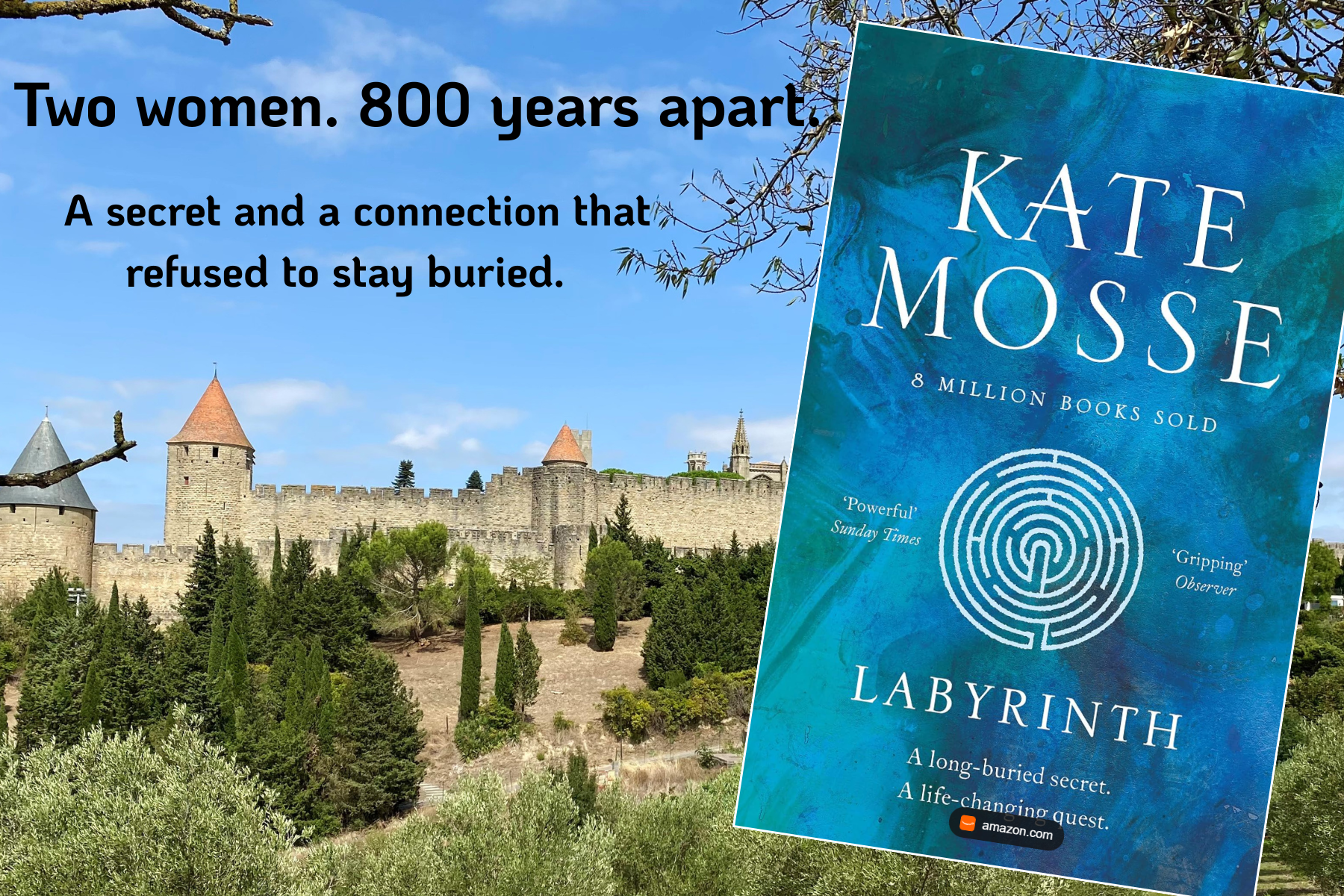
I came to “Labyrinth” through a recommendation from one of the ladies who was going to be travelling with me on an upcoming Plantagenets in France tour. We were talking about Carcassonne and my growing fascination with the Albigensian Crusade when she suggested I read Kate Mosse's novel.
What a recommendation that turned out to be.
At that point I had read only one other novel set against the brutality of the Albigensian Crusade, but it had been enough to send me down yet another historical rabbit hole. I was becoming fascinated not only by the Cathars themselves, but by the landscape of southern France in which their story unfolded. “Labyrinth” arrived at exactly the right moment.
The novel takes us into the world of the Albigensian Crusade, launched in 1209 against the Cathars of Languedoc and followed by decades of conflict and persecution. Around that history Kate Mosse builds a much larger mystery involving secrets, manuscripts and legends surrounding the Holy Grail.
And then she gives us two women separated by almost eight hundred years.
The modern story begins in 2005 at an archaeological dig in southern France, where we meet Alice Tanner. A discovery at the site draws her into a mystery she doesn't yet understand and gradually begins to connect her with events that took place centuries before.
The second story takes us back to Carcassonne in 1209 and seventeen-year-old Alaïs, whose world is about to be torn apart by the arrival of the crusading army. Through her, the events of the Albigensian Crusade stop being dates and battles and become the story of people caught in something terrifying that is unfolding around them.
Dual timelines can be a little hit and miss for me. I don't particularly seek them out, but I don't avoid them either. In “Labyrinth”, however, I couldn't imagine the story being told any other way. The movement between 1209 and 2005 is fundamental to the mystery, and rather than feeling as though I was reading two separate stories, I became increasingly interested in discovering exactly how they were connected.
That surprised me because mystery novels aren't usually what I reach for. Leave me in the historical section of a bookshop and I'm perfectly happy. Yet this time I became completely caught up in trying to work out not only who was connected to whom, but what on earth was actually going on.
And I loved it.
Perhaps part of the reason it worked so well for me was that the mystery was wrapped around a period of history that already fascinated me. Every time another historical detail appeared, I wanted to know more. I found myself wondering which elements came from the historical record, which belonged to local legend and which had come entirely from Kate's imagination.
There was another layer to my enjoyment too. I was due to visit the south of France later that year, and suddenly the places on my itinerary had acquired another dimension. I was listening to descriptions of Carcassonne and the landscapes of Languedoc knowing that before long I would actually be standing there. I was already wondering which details from the novel I might recognise and what I would discover once I began exploring the history for myself.
There are certain books that stay with me long after I've finished them. Mention the title years later and I can immediately remember how I felt while reading them, and before long I'm trying to persuade somebody else that they absolutely must read them too.
“Labyrinth” became one of those books.
And perhaps the greatest compliment I can give it is what happened afterwards. That curiosity about the Cathars and the Albigensian Crusade didn't disappear when I reached the end of the book. I went to southern France. I stood in the places I had been reading about. I kept researching, kept asking questions and kept disappearing down those rabbit holes.
Eventually, that fascination would lead me somewhere I could never have imagined when I first opened “Labyrinth”: to creating an entire Plantagenet Discoveries tour devoted to telling The Cathar story.
So yes, this one has a very special place on my bookshelf.