The Stone Rose by Carol McGrath
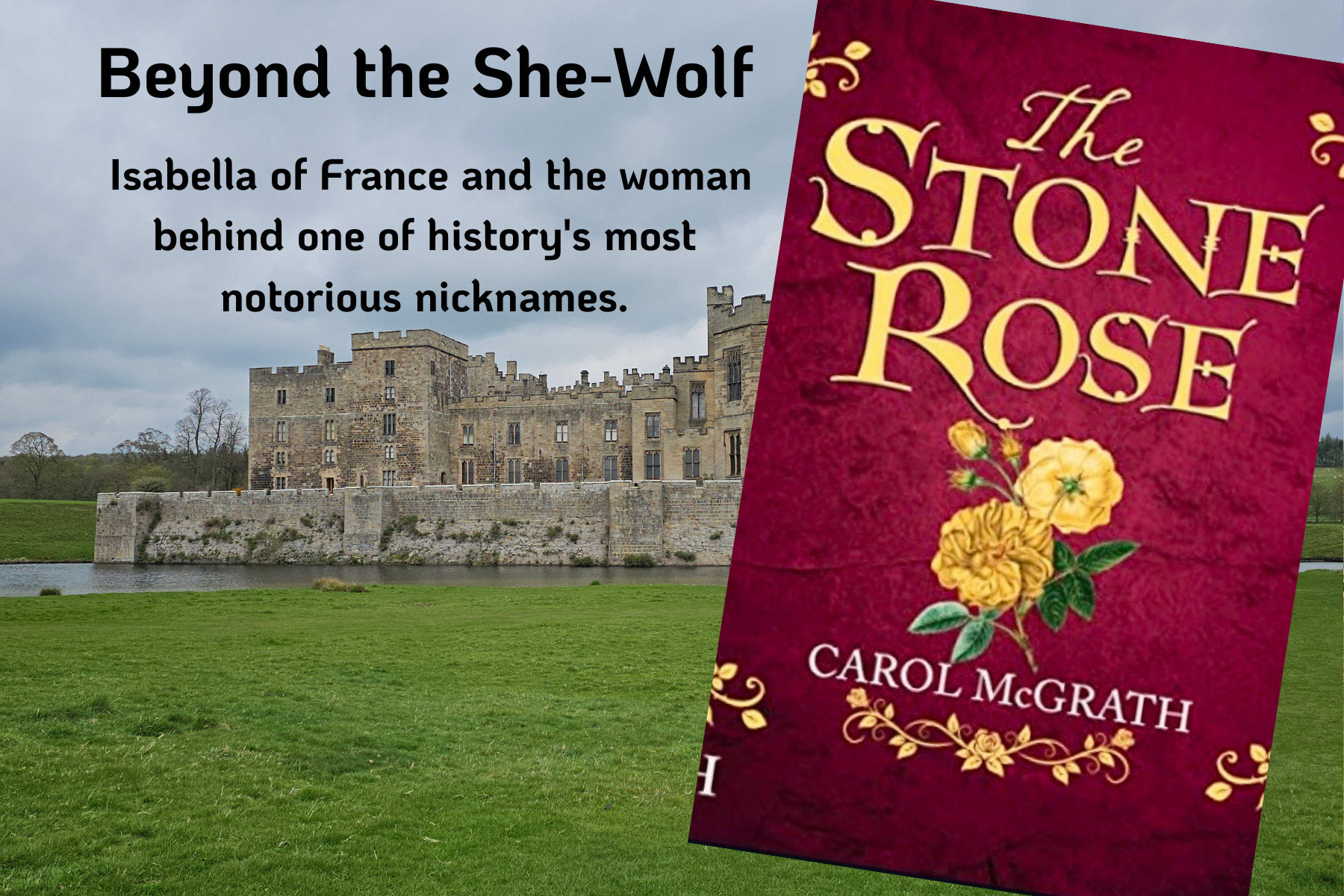
Isabella of France has come down through history as the notorious “She-Wolf of France”, the queen who invaded England and helped overthrow her husband, Edward II.
But behind that formidable reputation was a woman whose story was far more complicated. In “The Stone Rose”, Carol McGrath explores the woman behind the nickname and asks us to consider how Isabella reached that extraordinary point in her life.
As an avid reader who is always on the lookout for fresh material, I was thrilled when Carol reached out through my website to tell me about her latest book, centred around Richard the Lionheart's queen, Berengaria. Having devoured the recent releases from my favourite authors, and because unfortunately it takes these authors much longer to research and write novels than it does for me to read them, I went looking to see what else Carol had written.
That was how I discovered her She-Wolves Trilogy, which follows the lives of three remarkable queens of England. “The Stone Rose”, the final book in the trilogy, very quickly found its way towards the top of my favourites list.
One of the things I enjoy about historical fiction is seeing how different authors approach a story I already know. They may be working with many of the same historical events, but their research and interpretation can lead us to look at the people involved from an entirely different perspective.
Most of us who know the story of Isabella of France are familiar with the broad strokes. She was the queen consort of Edward II, fled to France, returned to England with an invading force alongside Roger Mortimer, helped overthrow her husband and saw her son Edward placed on the throne.
But how did she get there?
What happened to the young queen who had once been a loving and supportive wife? What brought her to the point where she was prepared to turn against her husband and ultimately participate in his deposition? This was the Isabella I wanted to understand, and Carol gave me plenty to think about.
I particularly love a historical novel that sends me back down the proverbial rabbit hole. Over more than two decades, those rabbit holes have helped me gradually piece together the chronology of this period and discover people I might otherwise never have encountered. “The Stone Rose” did exactly that. I found myself wanting to know more about some of the lesser-known figures in Edward II's court rather than simply revisiting familiar names such as Piers Gaveston and Hugh Despenser the Younger.
What I particularly enjoyed was the way Carol allowed us to see events from more than one perspective. Isabella's story is accompanied in part by that of a young man in her employ who, although fictional, provides another set of eyes through which to view what is happening. Carol also intertwines the story of a young stonemason commissioned to create an effigy of Isabella many years after the controversial events of her marriage.
I thought that was particularly clever because their interpretations of events don't always agree. And isn't that so often the problem with history? Two people can witness the same event and come away with entirely different versions of what happened. Centuries later, we are left trying to make sense of the evidence and wondering where the truth lies.
The novel also made me think again about the position of medieval queens. Isabella was born into one of the most powerful royal families in Europe and married a king, yet even a woman in that extraordinary position lived in a world that placed very real limits on her influence. Carol explores the ways Isabella attempted to navigate those limitations and the political world surrounding her.
She also gives us an Isabella who genuinely cares for Edward, which makes what comes later far more interesting. Knowing that she would eventually return to England with Mortimer and play a part in overthrowing her husband inevitably left me wondering where the relationship would begin to fracture and how Carol would take us from one version of Isabella to the other.
And perhaps that is what I enjoyed most about “The Stone Rose”. The woman behind the famous “She-Wolf of France” label is far more interesting than the nickname itself.
For anyone fascinated by Isabella of France, Edward II and Roger Mortimer, or with an interest in the Plantagenets and the wider medieval world, I would happily recommend this one.