Master of War Series by David Gilman
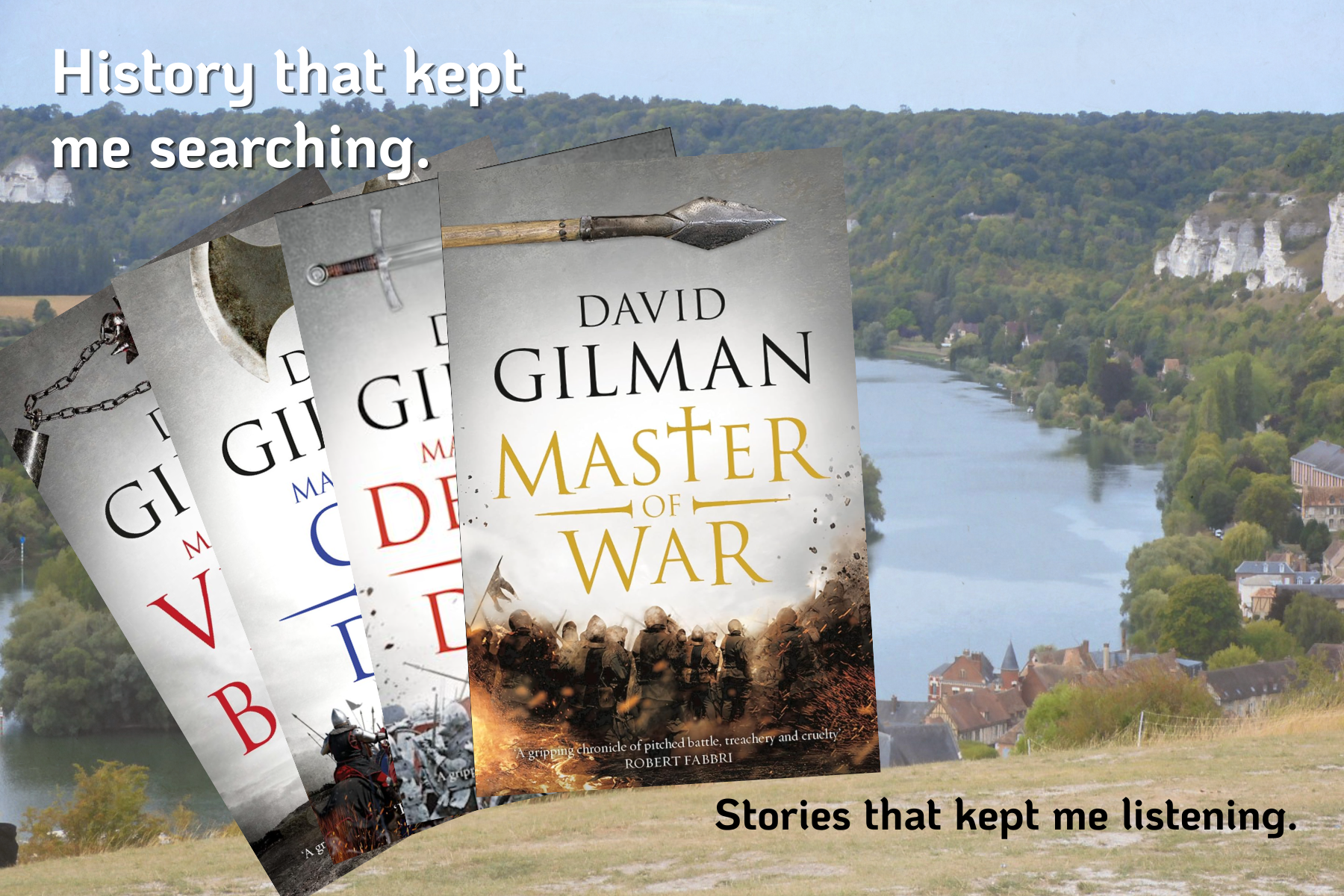
David Gilman’s Master of War series follows the life of Thomas Blackstone, a young English archer whose story begins around the time of the Battle of Crécy and carries us through the turmoil of the Hundred Years’ War.
I came to this series already fascinated by the Plantagenets and the Hundred Years’ War, and soon found myself completely caught up in Thomas Blackstone’s world.
It turned out there was far more waiting for me in these books than a great historical adventure.
I have a habit when listening to historical fiction. If an author introduces me to something I didn't know, sooner or later the audiobook is paused and I'm disappearing down a historical rabbit hole to find out more. David Gilman's Master of War series sent me down rather a lot of them.
I first discovered David through A Slice of Medieval, the podcast hosted by historical authors Derek Birks and Sharon Bennett Connolly. He was discussing one of the later books in the series and, with my fascination for the medieval longbow, the Hundred Years' War and Bernard Cornwell's Grail Quest novels, it didn't take much convincing. I downloaded the books and started listening.
The further I travelled with Thomas Blackstone, the more questions I found myself asking. My own Plantagenet research had naturally given me a predominantly English perspective on the Hundred Years' War. David's stories continually pushed me to look across the Channel and think more deeply about what was happening within France as well.
One aspect that particularly caught my attention in the early books was the complicated question of loyalty. As Thomas Blackstone moves through France, we meet nobles whose allegiance to the French Crown was not necessarily as straightforward as I had imagined. Geoffrey de Harcourt is a fascinating historical example of just how complicated those loyalties could become. A Norman nobleman, he eventually entered Edward III's service and accompanied the English king during the 1346 campaign in Normandy. At Crécy, Geoffrey fought for Edward while his own brother, Jean, fought on the French side and was killed in the battle.
I was familiar with the problem of divided loyalties from the earlier Plantagenet period, particularly when England's kings still held vast territories in France. I hadn't really considered how those questions of allegiance continued to play out generations later during the Hundred Years' War, and these novels made me curious about the politics within France itself.
The longbow was another reason the series appealed to me so strongly. I have always been fascinated by medieval archery, and Thomas Blackstone begins his story as an English archer at a time when the longbow was becoming one of the most important weapons in English warfare. By the Hundred Years’ War, massed archers were playing a decisive role in English armies, something demonstrated spectacularly at battles such as Crécy and, later, Agincourt.
What David does particularly well, though, is make the archers themselves matter. They aren't simply there to loose thousands of arrows across a battlefield. We come to know these men, their friendships, their loyalty to one another and the brutal reality of what was expected of them. Thomas may rise far beyond the circumstances into which he was born, but his connection to the archers and the men who fight beside him remains an important part of his story. And, unfortunately for me, David is quite prepared to kill some of them. There were deaths throughout the series that genuinely upset me, which presents a particular problem because I listen to most of my audiobooks while driving. Trying to see the road through tears because David Gilman has just killed someone I've become terribly attached to is not an ideal driving condition!
What affected me most as the series progressed was the way David brought the consequences of war beyond the battlefield into the story. Historical accounts so often draw our attention towards kings, queens, nobles and the political struggles that shaped their lives. These books repeatedly pulled my attention towards the people whose names rarely make it into the history books.
For those living off the land, the arrival of an army could be devastating. During the Hundred Years’ War, the English used raids known as chevauchées, moving through French territory while burning crops, taking livestock, destroying property and attacking the resources that supported both local communities and the French Crown. The strategy had a military and political purpose, but it was ordinary people who were left to live with much of the destruction.
David made that human cost very difficult to ignore. Following fictional families and communities caught in the path of armies made me think about the war differently. It is one thing to read about territory being invaded or a campaign succeeding; quite another to consider what those words meant for the people watching their crops burn or wondering how they were going to feed their families afterwards.
Perhaps the biggest surprise for me came when David introduced the Jacquerie of 1358. I knew the story of the English Peasants’ Revolt of 1381, but somehow this major uprising in France had completely escaped me. Naturally, that meant the audiobook was paused while I went off to find out what on earth had happened.
What I discovered was an uprising that erupted during an already desperate period for France. The country was suffering the effects of war, heavy taxation and political instability, while its king, Jean II, remained a prisoner of the English following his capture at the Battle of Poitiers. In parts of northern France, that anger and desperation exploded into violence. There was something else that caught my attention as I began reading more: the involvement of women. There is evidence that women participated in the Jacquerie, although the surviving records make it difficult to know exactly how extensive their involvement was. That uncertainty only made me more curious. Who were these women, what part did they play, and how many of their stories have simply disappeared from the record?
By the later books, the story had expanded into the Castilian Civil War and the struggle between Pedro of Castile and his half-brother, Henry of Trastámara. I hadn't fully appreciated just how closely events in Castile became entangled with the Hundred Years’ War. Edward, the Black Prince, intervened on Pedro's behalf, while the French supported Henry. Edward's campaign culminated in a remarkable victory at the Battle of Nájera in 1367, but what happened afterwards fascinated me just as much as the battle itself. Pedro failed to provide the money Edward had expected, leaving the prince facing enormous financial pressures after an extraordinarily expensive campaign.
I had always thought of the Hundred Years’ War primarily as a struggle between England and France, but David's books helped me appreciate just how much wider the political web could become. Alliances, rivalries and ambitions drew other kingdoms into the conflict, and events hundreds of miles away could have consequences back in England and France.
By the time I reached the end of the books available to me, my understanding of the Hundred Years’ War had broadened considerably. More importantly, I had become thoroughly invested in Thomas Blackstone and the people whose lives became entwined with his along the way.
That is probably what I value most in historical fiction. Give me a wonderful story and characters I care about, but leave me with questions too. I want to close the book knowing more than I did when I opened it, while still wanting to discover more for myself.
David Gilman's Master of War series gave me exactly that.
Every day really is a school day, and I couldn't ask for much more than that from historical fiction.